Turn your mortgage into a wealth-building tool. Smith Manoeuvre strategies, tax-smart planning, and honest math from two Canadian mortgage strategists.
BMO says Bank of Canada stability is one tariff away from collapse
The Bank of Canada has held its policy rate steady for six consecutive meetings, betting inflation will stay anchored near 2% without further intervention. That bet rests on one assumption: trade flows across the 49th parallel stay predictable.
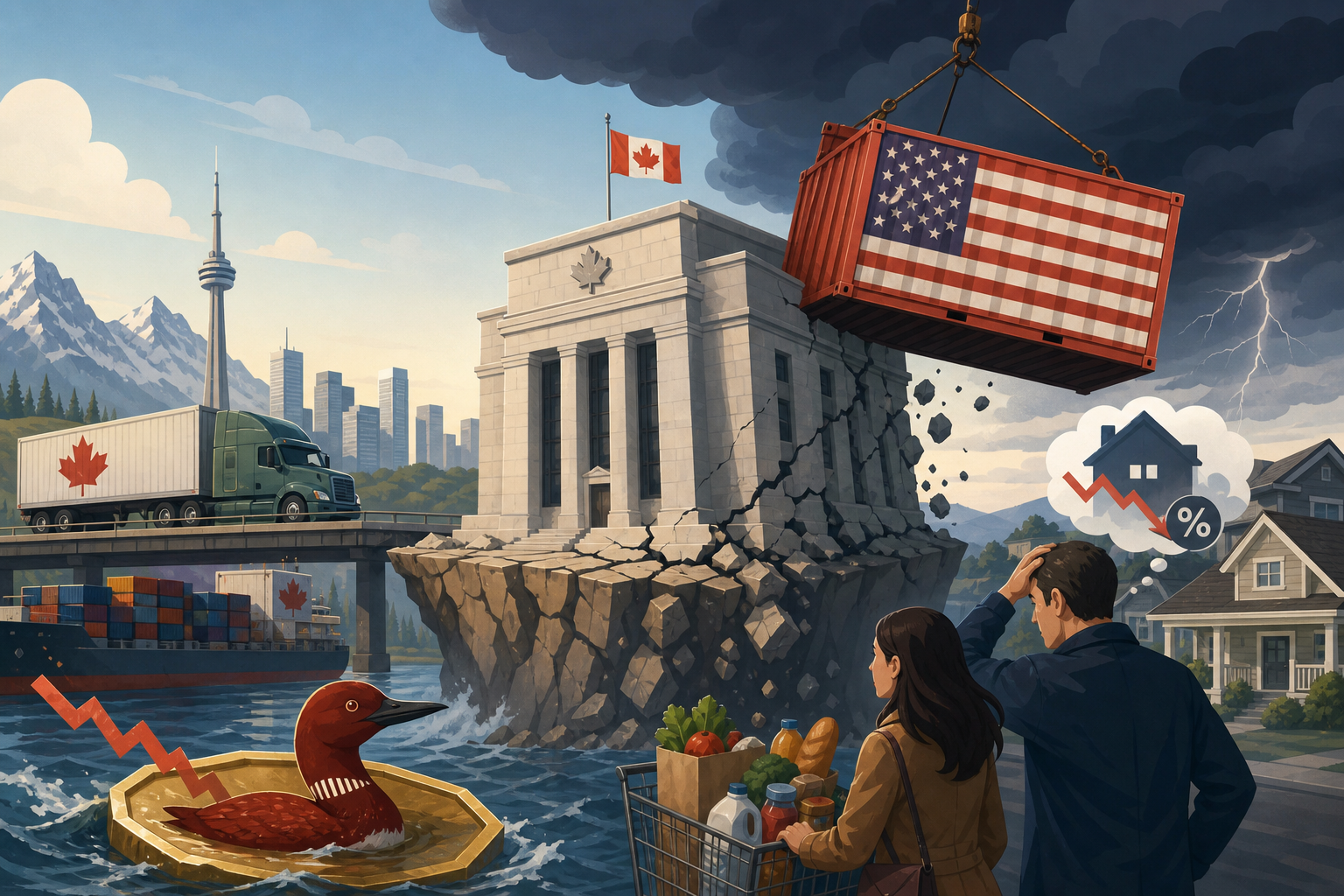
BMO Capital Markets says the assumption is fragile. If the current U.S. administration follows through on proposed universal baseline tariffs, floated at 10% on all imports, the central bank's "higher for longer" posture collapses. The policy pivot wouldn't signal economic strength. It would signal damage control.
Why tariffs force the central bank's hand
Tariffs do two things simultaneously. They raise the cost of imported goods, which pushes inflation up. And they choke cross-border trade, which slows growth. For most central banks, that's a coin flip: fight the price shock or cushion the slowdown.
Canada doesn't get a coin flip. Roughly 75% of Canadian exports flow to the United States, and about 30% of GDP is tied to export activity. The automotive corridor between Ontario and Michigan is so tightly integrated that tariffs would halt production lines within days, not quarters. When the growth hit is structural and immediate, inflation becomes the secondary problem.
BMO's calculus is straightforward. The contractionary effect of losing export market access outweighs the inflationary pressure from higher import costs, especially in a commodity-heavy economy where demand destruction shows up faster than price stickiness. That arithmetic puts rate cuts back on the table, even if headline inflation hasn't fully settled.
The irony is that the Bank of Canada spent 2024 and early 2025 rebuilding credibility on price stability after the inflation surge that peaked in mid-2022. Cutting rates into a tariff-driven price shock risks undoing that work. But letting the economy contract without a response risks something worse: a recession that could have been mitigated.
The currency problem nobody mentions
If the Bank of Canada cuts while the U.S. Federal Reserve holds rates elevated, the Canadian dollar weakens. That's not speculative, it's mechanical. A weaker loonie makes Canadian exports cheaper in USD terms, which partially offsets tariff costs for U.S. buyers.
That sounds like a win until you flip the lens. A falling currency makes everything Canadians import more expensive. Groceries, electronics, fuel, pharmaceuticals, all priced in a depreciated dollar. The central bank's rate cut, intended to shield the economy from a trade war, ends up amplifying inflation for households.
This is the part where central banking stops being about models and starts being about choosing which group absorbs the shock. Export-sector workers or urban consumers. Mortgage holders or retirees on fixed income. There's no version of this where everyone wins.
The CUSMA review makes this immediate
The timing isn't coincidental. The Canada-United States-Mexico Agreement comes up for joint review in 2026, and tariff threats are negotiating leverage. Whether the threats materialize or not, the uncertainty alone tightens financial conditions. Businesses delay investment. Hiring slows. Supply chains start exploring alternatives.
By the time tariffs are formally implemented, the economic damage is already partly baked in. The Bank of Canada's decision tree isn't "wait and see." It's "act preemptively or manage a deeper contraction later."
BMO's baseline still assumes no tariffs and no cuts in 2026. But the gap between baseline and contingency has narrowed to the width of a policy announcement from Washington. The central bank's stability isn't built on domestic fundamentals anymore. It's one headline away from revision.



The Bank of Canada has held its policy rate steady for six consecutive meetings, betting inflation will stay anchored near 2% without further intervention. That bet rests on one assumption: trade flows across the 49th parallel stay predictable.
BMO Capital Markets says the assumption is fragile. If the current U.S. administration follows through on proposed universal baseline tariffs, floated at 10% on all imports, the central bank's "higher for longer" posture collapses. The policy pivot wouldn't signal economic strength. It would signal damage control.
Why tariffs force the central bank's hand
Tariffs do two things simultaneously. They raise the cost of imported goods, which pushes inflation up. And they choke cross-border trade, which slows growth. For most central banks, that's a coin flip: fight the price shock or cushion the slowdown.
Canada doesn't get a coin flip. Roughly 75% of Canadian exports flow to the United States, and about 30% of GDP is tied to export activity. The automotive corridor between Ontario and Michigan is so tightly integrated that tariffs would halt production lines within days, not quarters. When the growth hit is structural and immediate, inflation becomes the secondary problem.
BMO's calculus is straightforward. The contractionary effect of losing export market access outweighs the inflationary pressure from higher import costs, especially in a commodity-heavy economy where demand destruction shows up faster than price stickiness. That arithmetic puts rate cuts back on the table, even if headline inflation hasn't fully settled.
The irony is that the Bank of Canada spent 2024 and early 2025 rebuilding credibility on price stability after the inflation surge that peaked in mid-2022. Cutting rates into a tariff-driven price shock risks undoing that work. But letting the economy contract without a response risks something worse: a recession that could have been mitigated.
The currency problem nobody mentions
If the Bank of Canada cuts while the U.S. Federal Reserve holds rates elevated, the Canadian dollar weakens. That's not speculative, it's mechanical. A weaker loonie makes Canadian exports cheaper in USD terms, which partially offsets tariff costs for U.S. buyers.
That sounds like a win until you flip the lens. A falling currency makes everything Canadians import more expensive. Groceries, electronics, fuel, pharmaceuticals, all priced in a depreciated dollar. The central bank's rate cut, intended to shield the economy from a trade war, ends up amplifying inflation for households.
This is the part where central banking stops being about models and starts being about choosing which group absorbs the shock. Export-sector workers or urban consumers. Mortgage holders or retirees on fixed income. There's no version of this where everyone wins.
The CUSMA review makes this immediate
The timing isn't coincidental. The Canada-United States-Mexico Agreement comes up for joint review in 2026, and tariff threats are negotiating leverage. Whether the threats materialize or not, the uncertainty alone tightens financial conditions. Businesses delay investment. Hiring slows. Supply chains start exploring alternatives.
By the time tariffs are formally implemented, the economic damage is already partly baked in. The Bank of Canada's decision tree isn't "wait and see." It's "act preemptively or manage a deeper contraction later."
BMO's baseline still assumes no tariffs and no cuts in 2026. But the gap between baseline and contingency has narrowed to the width of a policy announcement from Washington. The central bank's stability isn't built on domestic fundamentals anymore. It's one headline away from revision.
Read Next
The Fed Hold Everyone Expects Will Sink the Dollar Anyway
Realtors Are Walking Away, And the Prenup Surge Tells You Why
Realtors Are Leaving the Industry, and the Numbers Tell You Why
Kelowna Now Ranks First in Canada for Wildfire Risk: What Condo Buyers Need to Verify Before Closing