Turn your mortgage into a wealth-building tool. Smith Manoeuvre strategies, tax-smart planning, and honest math from two Canadian mortgage strategists.
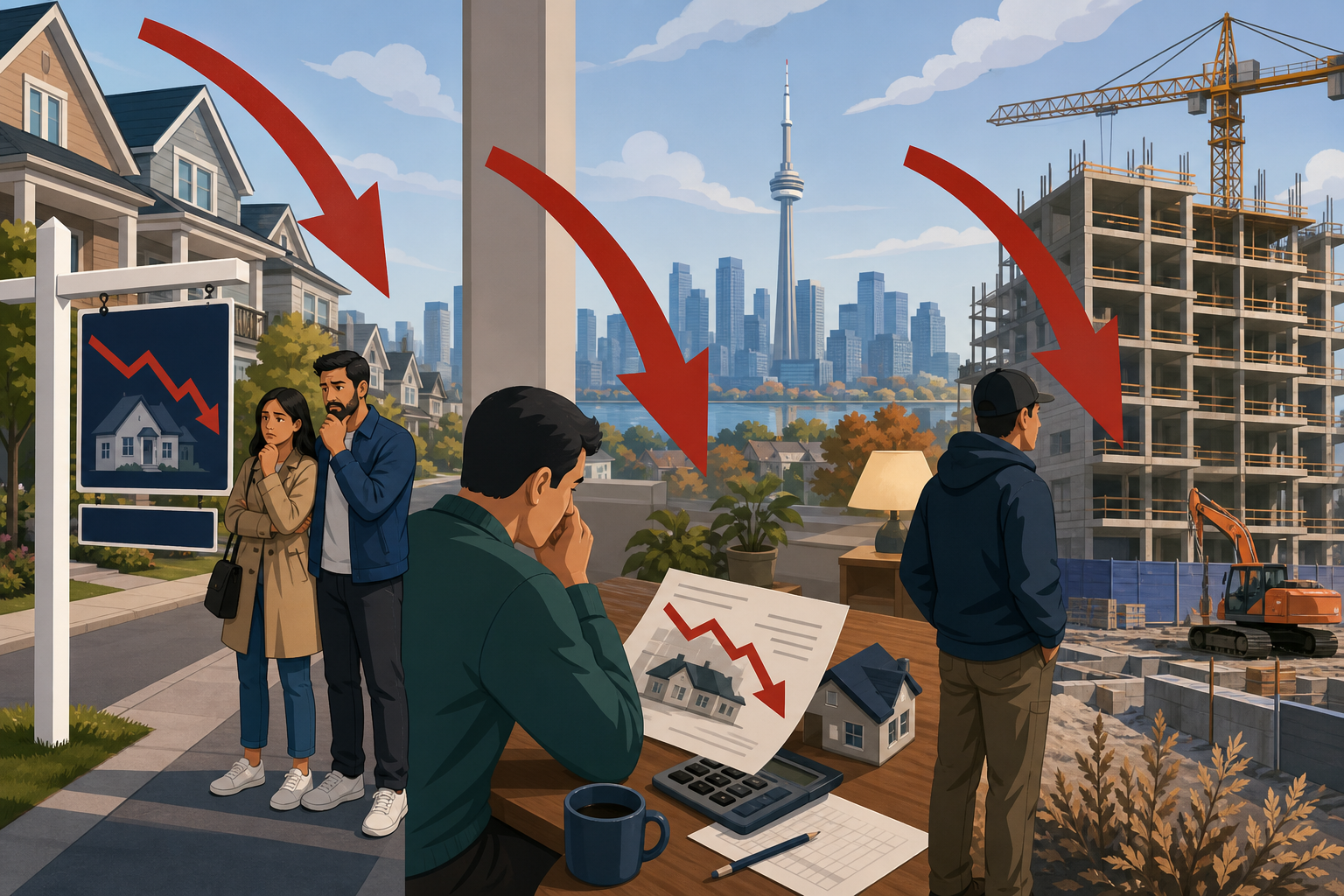
CMHC's 2026 forecast marks a triple decline: sales, prices, and starts all falling together
A 47-year-old accountant in Brampton refinanced his mortgage in March 2021 at 1.64%. When his term expires next spring, the lowest available rate will be north of 4%. His monthly payment will jump by $890. He has decided to wait.
That story is playing out in roughly 300,000 households across the Greater Toronto Area alone. The result is not just hesitation. It is a structural freeze in the resale market that has begun to feed on itself.
Why all three metrics are falling at once
Housing markets typically see one indicator weaken while others hold. Sales drop but starts remain strong. Prices soften but transaction volume stays stable. The CMHC's 2026 outlook is unusual because it projects simultaneous declines across all three: fewer transactions, lower prices, and housing starts falling below 200,000 units nationally for the first time since 2020.
The mechanism behind this alignment is straightforward. High borrowing costs have locked existing owners in place, which reduces supply. But those same costs have priced out most first-time buyers, which reduces demand even more. The imbalance creates downward pressure on prices. Falling prices, in turn, spook developers who were already facing negative carry on new projects. Construction financing at current rates makes penciling out a new rental building nearly impossible unless rents rise another 15%, which they won't in a market where buyers are turning into renters faster than renters are turning into buyers.
The result is a market where everyone is waiting for someone else to move first.
The buyer's paradox
Listings in the Greater Vancouver Area have climbed 22% year-over-year, the highest inventory accumulation in a decade. In theory, more supply should mean better affordability. In practice, it hasn't.
Monthly carrying costs, mortgage, property tax, strata fees, on a median two-bedroom condo in Burnaby now exceed $4,100 at prevailing rates. A year ago, the same unit sold for 8% more but cost $3,750 a month to carry because rates were 60 basis points lower. The price has fallen. Affordability has not improved.
This is the paradox buyers are facing in 2026. Prices are softening, but the cost of borrowing remains high enough that the payment-to-income ratio for the median household has barely budged. Families who were priced out at the peak are still priced out at the trough.
What happens when starts fall during a price dip
Housing economists worry less about today's price correction than about the lag it creates. Starts are a leading indicator of supply three to five years out. When they fall below replacement levels, which they are now doing, the market sets up a future price spike the moment financing costs normalize.
Canada has added roughly 1.2 million people net since 2021. Over the same period, completions have totaled fewer than 900,000 units. The structural deficit was already severe. Cutting starts in 2026 to below 200,000 units makes it worse.
The federal government's moves to reduce temporary residents from 6.2% of the population down to 5% will dampen rental demand in the near term, which may relieve some pressure. But immigration targets for permanent residents remain above 450,000 annually. Those people need housing. Fewer starts today means tighter supply in 2029.
The floor no one is pricing in
Mortgage arrears have ticked upward in Calgary, Toronto, and Vancouver, but they remain well below historical stress levels. The unemployment rate sits at 5.8% nationally. Job losses are the catalyst for housing crashes, not rate hikes alone.
What the market is experiencing now is not a collapse. It is a repricing combined with a liquidity trap. Sellers who need to move are cutting asks. Sellers who don't need to move are pulling listings and waiting. Buyers are doing the same. The danger is not that prices fall too far. The danger is that the market stays frozen long enough that the supply deficit compounds into something policy can't fix quickly when rates eventually come down.



A 47-year-old accountant in Brampton refinanced his mortgage in March 2021 at 1.64%. When his term expires next spring, the lowest available rate will be north of 4%. His monthly payment will jump by $890. He has decided to wait.
That story is playing out in roughly 300,000 households across the Greater Toronto Area alone. The result is not just hesitation. It is a structural freeze in the resale market that has begun to feed on itself.
Why all three metrics are falling at once
Housing markets typically see one indicator weaken while others hold. Sales drop but starts remain strong. Prices soften but transaction volume stays stable. The CMHC's 2026 outlook is unusual because it projects simultaneous declines across all three: fewer transactions, lower prices, and housing starts falling below 200,000 units nationally for the first time since 2020.
The mechanism behind this alignment is straightforward. High borrowing costs have locked existing owners in place, which reduces supply. But those same costs have priced out most first-time buyers, which reduces demand even more. The imbalance creates downward pressure on prices. Falling prices, in turn, spook developers who were already facing negative carry on new projects. Construction financing at current rates makes penciling out a new rental building nearly impossible unless rents rise another 15%, which they won't in a market where buyers are turning into renters faster than renters are turning into buyers.
The result is a market where everyone is waiting for someone else to move first.
The buyer's paradox
Listings in the Greater Vancouver Area have climbed 22% year-over-year, the highest inventory accumulation in a decade. In theory, more supply should mean better affordability. In practice, it hasn't.
Monthly carrying costs, mortgage, property tax, strata fees, on a median two-bedroom condo in Burnaby now exceed $4,100 at prevailing rates. A year ago, the same unit sold for 8% more but cost $3,750 a month to carry because rates were 60 basis points lower. The price has fallen. Affordability has not improved.
This is the paradox buyers are facing in 2026. Prices are softening, but the cost of borrowing remains high enough that the payment-to-income ratio for the median household has barely budged. Families who were priced out at the peak are still priced out at the trough.
What happens when starts fall during a price dip
Housing economists worry less about today's price correction than about the lag it creates. Starts are a leading indicator of supply three to five years out. When they fall below replacement levels, which they are now doing, the market sets up a future price spike the moment financing costs normalize.
Canada has added roughly 1.2 million people net since 2021. Over the same period, completions have totaled fewer than 900,000 units. The structural deficit was already severe. Cutting starts in 2026 to below 200,000 units makes it worse.
The federal government's moves to reduce temporary residents from 6.2% of the population down to 5% will dampen rental demand in the near term, which may relieve some pressure. But immigration targets for permanent residents remain above 450,000 annually. Those people need housing. Fewer starts today means tighter supply in 2029.
The floor no one is pricing in
Mortgage arrears have ticked upward in Calgary, Toronto, and Vancouver, but they remain well below historical stress levels. The unemployment rate sits at 5.8% nationally. Job losses are the catalyst for housing crashes, not rate hikes alone.
What the market is experiencing now is not a collapse. It is a repricing combined with a liquidity trap. Sellers who need to move are cutting asks. Sellers who don't need to move are pulling listings and waiting. Buyers are doing the same. The danger is not that prices fall too far. The danger is that the market stays frozen long enough that the supply deficit compounds into something policy can't fix quickly when rates eventually come down.
Read Next
The Fed Hold Everyone Expects Will Sink the Dollar Anyway
Realtors Are Walking Away, And the Prenup Surge Tells You Why
Realtors Are Leaving the Industry, and the Numbers Tell You Why
Kelowna Now Ranks First in Canada for Wildfire Risk: What Condo Buyers Need to Verify Before Closing