Turn your mortgage into a wealth-building tool. Smith Manoeuvre strategies, tax-smart planning, and honest math from two Canadian mortgage strategists.
How to Layer Ontario's HST Rebate With Your FHSA to Cut $30,000+ From a New Build
A 47-year-old engineer in Mississauga who bought a $650,000 pre-construction townhouse in 2023 walked into closing with $31,400 less cash required than his mortgage broker originally quoted. He didn't renegotiate the price. The builder used the provincial HST rebate to lower the amount payable at closing, he pulled $40,000 from a maxed FHSA, withdrew $35,000 from his RRSP under the Home Buyers' Plan, and claimed the full Ontario land transfer tax refund. Four programs, one closing, zero tax on any of it.
Most buyers treat these as separate moves. The actual value is in the timing and the order.
Start with the FHSA, Not the RRSP
The FHSA is the only account where contributions are tax-deductible and withdrawals for a home purchase are completely tax-free. No repayment, no clawback, no strings. You can contribute $8,000 a year up to a $40,000 lifetime cap. If you opened one in 2023, you can max it by 2028.
The RRSP Home Buyers' Plan lets you pull $60,000 tax-free, but you have to pay it back over 15 years. Miss a year and the CRA adds that portion to your taxable income. The FHSA has no such requirement. Front-load it first. Use the HBP only if you need more than $40,000 in liquid capital for the down payment.
A couple can access $200,000 between two FHSAs and two RRSPs. That's often enough to cover a 20% down payment on a $650,000 new build in Ottawa or Kitchener without touching a TFSA or taxable account.
The HST Rebate Isn't a Cheque
Ontario's provincial HST rebate on new construction tops out at $24,000 for homes priced around $400,000. The rebate shrinks as the price climbs and phases out entirely above $450,000 for the provincial portion. The federal GST rebate has a separate cap of $6,300 and phases out above $350,000.
Here's what trips people up: you don't get a cheque. The builder applies the rebate and reduces what you owe at closing. If the contract says $650,000, the builder has likely already deducted the rebate from that figure. Read the purchase agreement. If the rebate is not assigned to the builder, you'll need to file for it separately after closing, which means paying the full HST upfront.
The rebate only applies if the home is your primary residence. If you flip the contract through an assignment sale or rent it out immediately, the CRA can demand the rebate back with interest. Some builders now write clauses requiring buyers to confirm occupancy within a set window.
Land Transfer Tax Refund Covers What the Rebate Doesn't
Ontario first-time buyers can claim up to $4,000 back on the provincial land transfer tax. Toronto residents get an additional municipal rebate. These refunds don't reduce the purchase price. They offset a closing cost you'd otherwise pay out of pocket.
On a $650,000 home, the provincial LTT is roughly $8,475. The $4,000 refund cuts that to $4,475. It's not huge, but it's real cash you'd otherwise need at closing alongside legal fees, title insurance, and moving costs. Legal fees alone run $1,500 to $2,500 for a standard residential transaction.
Most lawyers file the LTT refund automatically if you qualify. Confirm this during your retainer discussion. Some firms charge a separate fee for the filing.
The Repayment Trap
The FHSA doesn't require repayment. The HBP does. You have until the end of the second year after withdrawal to start paying it back. If you withdrew $60,000 in 2024, your first repayment is due by the end of 2026. The CRA expects $4,000 a year for 15 years.
If you skip a year, that $4,000 gets added to your taxable income. At a 35% marginal rate, you'll owe $1,400 in tax on money you already spent. The penalty isn't immediate, but it compounds if you fall behind multiple years.
Set up an automatic RRSP contribution equal to one-fifteenth of your HBP withdrawal the month after you close. If you don't see the money, you won't spend it.
The One Thing Nobody Mentions
If you max the FHSA and don't buy within 15 years, you can roll the full balance into your RRSP without affecting your existing contribution room. It's an extra $40,000 in retirement savings on top of your annual limit. That's the only outcome where the FHSA acts like an RRSP with a bonus.
Most people buy before year 15. But if your plans change, you're not locked into losing the tax shelter.


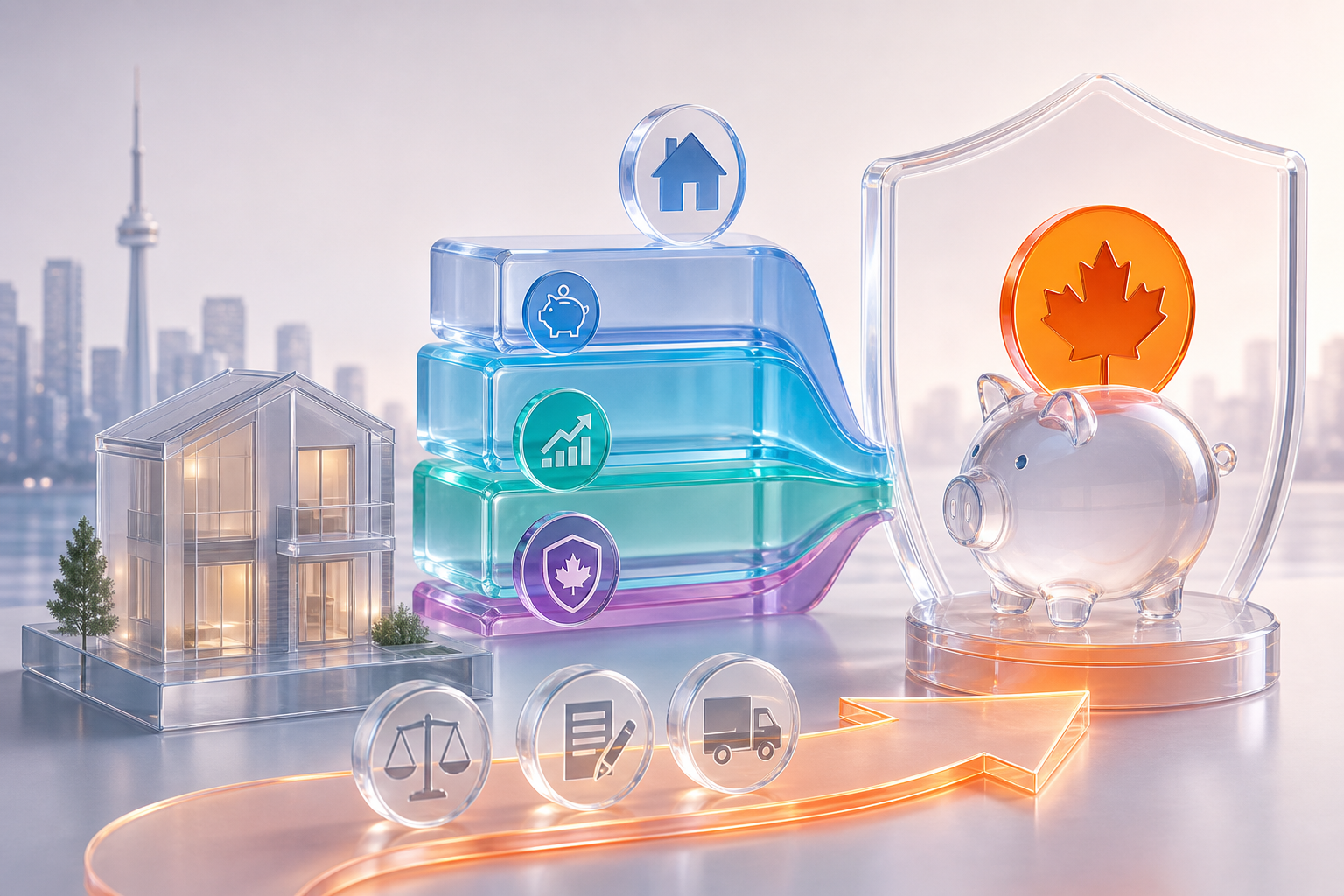

A 47-year-old engineer in Mississauga who bought a $650,000 pre-construction townhouse in 2023 walked into closing with $31,400 less cash required than his mortgage broker originally quoted. He didn't renegotiate the price. The builder used the provincial HST rebate to lower the amount payable at closing, he pulled $40,000 from a maxed FHSA, withdrew $35,000 from his RRSP under the Home Buyers' Plan, and claimed the full Ontario land transfer tax refund. Four programs, one closing, zero tax on any of it.
Most buyers treat these as separate moves. The actual value is in the timing and the order.
Start with the FHSA, Not the RRSP
The FHSA is the only account where contributions are tax-deductible and withdrawals for a home purchase are completely tax-free. No repayment, no clawback, no strings. You can contribute $8,000 a year up to a $40,000 lifetime cap. If you opened one in 2023, you can max it by 2028.
The RRSP Home Buyers' Plan lets you pull $60,000 tax-free, but you have to pay it back over 15 years. Miss a year and the CRA adds that portion to your taxable income. The FHSA has no such requirement. Front-load it first. Use the HBP only if you need more than $40,000 in liquid capital for the down payment.
A couple can access $200,000 between two FHSAs and two RRSPs. That's often enough to cover a 20% down payment on a $650,000 new build in Ottawa or Kitchener without touching a TFSA or taxable account.
The HST Rebate Isn't a Cheque
Ontario's provincial HST rebate on new construction tops out at $24,000 for homes priced around $400,000. The rebate shrinks as the price climbs and phases out entirely above $450,000 for the provincial portion. The federal GST rebate has a separate cap of $6,300 and phases out above $350,000.
Here's what trips people up: you don't get a cheque. The builder applies the rebate and reduces what you owe at closing. If the contract says $650,000, the builder has likely already deducted the rebate from that figure. Read the purchase agreement. If the rebate is not assigned to the builder, you'll need to file for it separately after closing, which means paying the full HST upfront.
The rebate only applies if the home is your primary residence. If you flip the contract through an assignment sale or rent it out immediately, the CRA can demand the rebate back with interest. Some builders now write clauses requiring buyers to confirm occupancy within a set window.
Land Transfer Tax Refund Covers What the Rebate Doesn't
Ontario first-time buyers can claim up to $4,000 back on the provincial land transfer tax. Toronto residents get an additional municipal rebate. These refunds don't reduce the purchase price. They offset a closing cost you'd otherwise pay out of pocket.
On a $650,000 home, the provincial LTT is roughly $8,475. The $4,000 refund cuts that to $4,475. It's not huge, but it's real cash you'd otherwise need at closing alongside legal fees, title insurance, and moving costs. Legal fees alone run $1,500 to $2,500 for a standard residential transaction.
Most lawyers file the LTT refund automatically if you qualify. Confirm this during your retainer discussion. Some firms charge a separate fee for the filing.
The Repayment Trap
The FHSA doesn't require repayment. The HBP does. You have until the end of the second year after withdrawal to start paying it back. If you withdrew $60,000 in 2024, your first repayment is due by the end of 2026. The CRA expects $4,000 a year for 15 years.
If you skip a year, that $4,000 gets added to your taxable income. At a 35% marginal rate, you'll owe $1,400 in tax on money you already spent. The penalty isn't immediate, but it compounds if you fall behind multiple years.
Set up an automatic RRSP contribution equal to one-fifteenth of your HBP withdrawal the month after you close. If you don't see the money, you won't spend it.
The One Thing Nobody Mentions
If you max the FHSA and don't buy within 15 years, you can roll the full balance into your RRSP without affecting your existing contribution room. It's an extra $40,000 in retirement savings on top of your annual limit. That's the only outcome where the FHSA acts like an RRSP with a bonus.
Most people buy before year 15. But if your plans change, you're not locked into losing the tax shelter.
Read Next
The Fed Hold Everyone Expects Will Sink the Dollar Anyway
Realtors Are Walking Away, And the Prenup Surge Tells You Why
Realtors Are Leaving the Industry, and the Numbers Tell You Why
Kelowna Now Ranks First in Canada for Wildfire Risk: What Condo Buyers Need to Verify Before Closing