Turn your mortgage into a wealth-building tool. Smith Manoeuvre strategies, tax-smart planning, and honest math from two Canadian mortgage strategists.
Living Near a Top School Costs 47% More: What Canada's School-Proximity Premium Means for Buyers
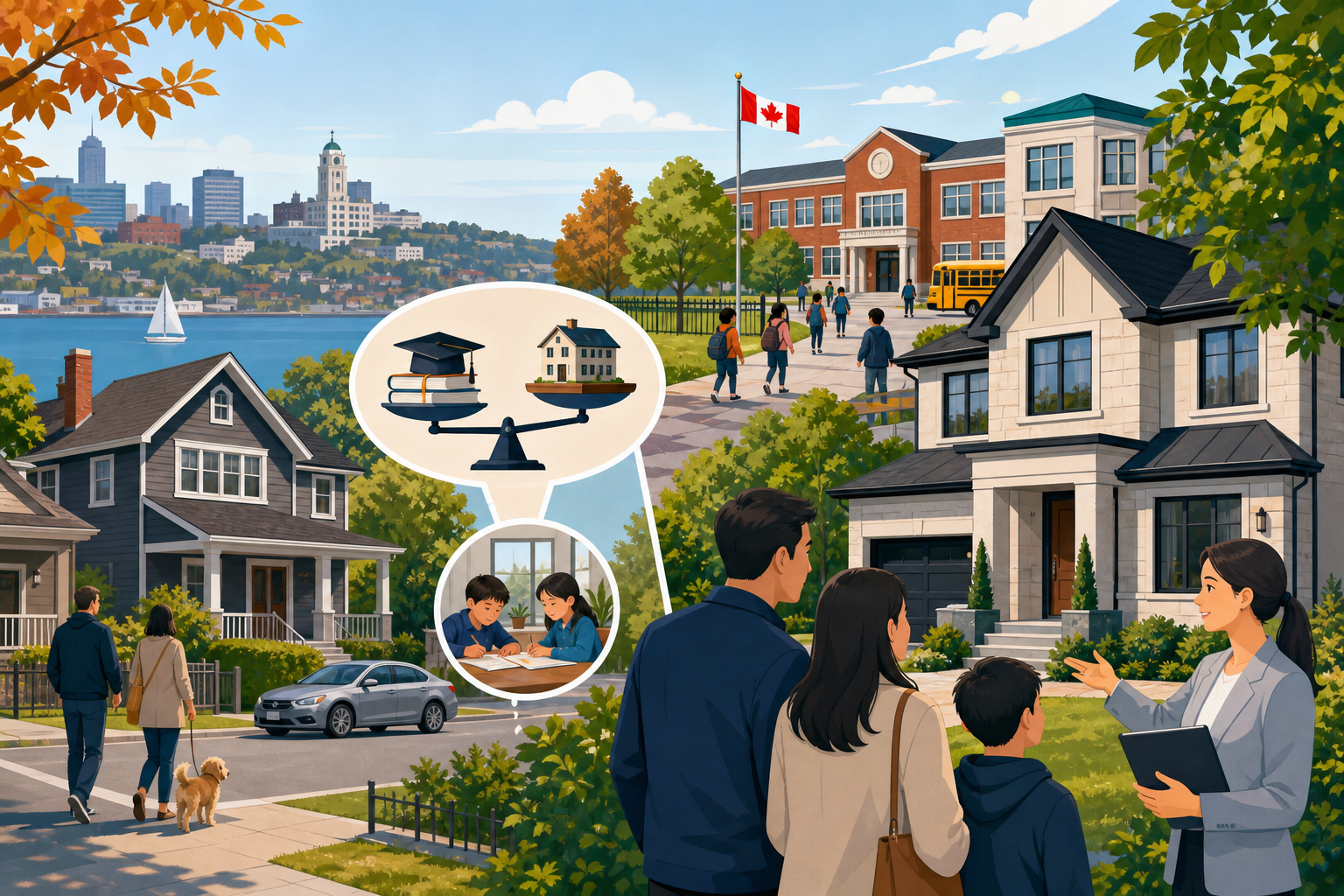
A detached house in North Toronto sits 200 meters from the catchment boundary of a high-ranked elementary school. The identical model across the street, outside the zone by one block, sold last month for $1.2 million. The house inside the boundary listed at $1.76 million and went firm in four days. The difference, $560,000, or roughly 47%, buys nothing but access to a specific building where children will spend six hours a day for seven years.
This is the education premium, and it operates less like a housing cost and more like invisible tuition paid through a mortgage instead of annual invoices. The calculation parents make is blunt: a $150,000 markup on a detached property in West Vancouver or the Annex costs less over a 25-year amortization than private school fees for two children, especially after accounting for the home's residual value. The premium becomes the equity component of what is functionally a pre-paid education product.
What complicates the math is that the premium itself isn't fixed, it migrates. As primary markets like Toronto and Vancouver push past affordability thresholds even for dual-income professional households, the school-proximity game has moved to secondary cities. Guelph, London, and parts of Halifax now exhibit the same catchment-driven price distortions that were once confined to the country's two most expensive metros. A bungalow within walking distance of a top-rated Halifax elementary that would have traded at $420,000 in 2019 now clears $680,000, while a comparable property three kilometers away, identical vintage, similar lot, sits at $510,000. The spread has widened as equity-rich buyers from Ontario and BC relocate, bringing the same willingness to pay for proximity they learned in their origin markets.
Why rankings drive dollars more than pedagogy
The Fraser Institute's school rankings, widely criticized for reflecting neighborhood income more than teaching quality, nonetheless function as the de facto valuation index for residential real estate. A school's score correlates strongly with the socioeconomic profile of its catchment, which means buyers are paying not for better instruction but for a peer group. The mechanism is self-reinforcing: high-income families cluster near high-ranked schools, driving up prices, which filters for high-income buyers, which maintains the ranking. The result is a feedback loop where the premium becomes proof of value, independent of what happens inside the classroom.
This creates a trap for long-term residents. In Halifax, where rental vacancy hovers near 1.0% and the province has capped annual rent increases, existing tenants can't afford to move even as newcomers bid up purchase prices around them. The property tax assessment cap, meant to protect longtime homeowners from gentrification pressure, has the perverse effect of locking people in place, reducing the supply of homes that might otherwise turn over. The school premium compounds this: a family that bought in a catchment zone in 2015 now sits on $300,000 in paper gains they can't realize without leaving the district, which would mean either accepting a lower-ranked school or paying an even steeper premium in another top zone.
The renovation wall
Higher borrowing costs have introduced a secondary distortion. Buyers who might have purchased a "fixer" in a premium catchment and renovated over two years now lack the credit appetite for staged improvements. The result is a widening gap between turnkey homes, which command the full premium, and properties requiring work, which sit longer and sell at discounts that didn't exist when money was cheaper. A semi-detached in Leaside listed as "investor special" in a top school zone might have cleared $1.1 million in 2021. Today it's $870,000, because the buyer willing to pay the education premium wants to move in immediately, and the buyer willing to renovate can't afford the land cost to begin with.
The invisible tuition model only works if the premium remains recoverable on exit. When catchment boundaries shift or rankings drop, the floor disappears.



A detached house in North Toronto sits 200 meters from the catchment boundary of a high-ranked elementary school. The identical model across the street, outside the zone by one block, sold last month for $1.2 million. The house inside the boundary listed at $1.76 million and went firm in four days. The difference, $560,000, or roughly 47%, buys nothing but access to a specific building where children will spend six hours a day for seven years.
This is the education premium, and it operates less like a housing cost and more like invisible tuition paid through a mortgage instead of annual invoices. The calculation parents make is blunt: a $150,000 markup on a detached property in West Vancouver or the Annex costs less over a 25-year amortization than private school fees for two children, especially after accounting for the home's residual value. The premium becomes the equity component of what is functionally a pre-paid education product.
What complicates the math is that the premium itself isn't fixed, it migrates. As primary markets like Toronto and Vancouver push past affordability thresholds even for dual-income professional households, the school-proximity game has moved to secondary cities. Guelph, London, and parts of Halifax now exhibit the same catchment-driven price distortions that were once confined to the country's two most expensive metros. A bungalow within walking distance of a top-rated Halifax elementary that would have traded at $420,000 in 2019 now clears $680,000, while a comparable property three kilometers away, identical vintage, similar lot, sits at $510,000. The spread has widened as equity-rich buyers from Ontario and BC relocate, bringing the same willingness to pay for proximity they learned in their origin markets.
Why rankings drive dollars more than pedagogy
The Fraser Institute's school rankings, widely criticized for reflecting neighborhood income more than teaching quality, nonetheless function as the de facto valuation index for residential real estate. A school's score correlates strongly with the socioeconomic profile of its catchment, which means buyers are paying not for better instruction but for a peer group. The mechanism is self-reinforcing: high-income families cluster near high-ranked schools, driving up prices, which filters for high-income buyers, which maintains the ranking. The result is a feedback loop where the premium becomes proof of value, independent of what happens inside the classroom.
This creates a trap for long-term residents. In Halifax, where rental vacancy hovers near 1.0% and the province has capped annual rent increases, existing tenants can't afford to move even as newcomers bid up purchase prices around them. The property tax assessment cap, meant to protect longtime homeowners from gentrification pressure, has the perverse effect of locking people in place, reducing the supply of homes that might otherwise turn over. The school premium compounds this: a family that bought in a catchment zone in 2015 now sits on $300,000 in paper gains they can't realize without leaving the district, which would mean either accepting a lower-ranked school or paying an even steeper premium in another top zone.
The renovation wall
Higher borrowing costs have introduced a secondary distortion. Buyers who might have purchased a "fixer" in a premium catchment and renovated over two years now lack the credit appetite for staged improvements. The result is a widening gap between turnkey homes, which command the full premium, and properties requiring work, which sit longer and sell at discounts that didn't exist when money was cheaper. A semi-detached in Leaside listed as "investor special" in a top school zone might have cleared $1.1 million in 2021. Today it's $870,000, because the buyer willing to pay the education premium wants to move in immediately, and the buyer willing to renovate can't afford the land cost to begin with.
The invisible tuition model only works if the premium remains recoverable on exit. When catchment boundaries shift or rankings drop, the floor disappears.
Read Next
The Fed Hold Everyone Expects Will Sink the Dollar Anyway
Realtors Are Walking Away, And the Prenup Surge Tells You Why
Realtors Are Leaving the Industry, and the Numbers Tell You Why
Kelowna Now Ranks First in Canada for Wildfire Risk: What Condo Buyers Need to Verify Before Closing