Turn your mortgage into a wealth-building tool. Smith Manoeuvre strategies, tax-smart planning, and honest math from two Canadian mortgage strategists.
EQB shares climbed 9% in a single session last July on news that seems straightforward until you look at what Loblaw actually gets for the money. The grocery chain disclosed plans to push its ownership stake in Equitable Bank's parent to nearly 25%, and the market read it as a retailer diversifying into finance. That reading misses the point. Loblaw isn't buying exposure to mortgage spreads. It's buying the pipes.
Equitable Bank is Canada's seventh-largest bank by assets and the platform underneath chunks of PC Financial's banking products. The relationship isn't new. What's new is Loblaw treating that relationship less like a vendor contract and more like owned infrastructure. A 25% stake doesn't get you board control, but it gets you something more durable: alignment on product roadmap, priority access to consumer credit data, and the ability to embed financial services so deeply into the loyalty ecosystem that competitors can't easily pry them loose.
The data play nobody wants to name
This isn't about dividends. Loblaw operates over 1,000 retail locations and holds transaction-level data on millions of Canadian households through PC Optimum. Equitable holds their mortgage history, deposit behavior, and credit utilization. Combining those datasets doesn't just improve targeted offers. It changes the underwriting model. A grocery chain that knows a customer's weekly spend, category mix, and purchase consistency has information a traditional credit bureau doesn't. A bank that can layer that onto credit decisions can price risk more accurately than one working off income statements and bureau scores alone.
The 25% threshold matters because it positions Loblaw close to the regulatory ceiling without crossing into "effective control" territory that would trigger stricter capital requirements under the Bank Act. Ownership of widely held banks in Canada caps at 20% for voting shares and 30% for non-voting without ministerial approval. Loblaw is threading that needle. The stake is large enough to matter operationally, small enough to avoid the full regulatory burden of ownership.
Implicit branch network, zero real estate cost
Equitable has no physical branches. Loblaw has 1,000 of them, and they sell milk. The implicit distribution channel here is harder to replicate than anything the Big Six could build. A Scotiabank can open a branch in a strip mall. It cannot turn its branches into places Canadians visit three times a week for reasons unrelated to banking. Loblaw's retail footprint functions as a soft branch network for Equitable's products without the operational cost of staffing teller lines or maintaining vaults. You can't acquire that. You have to own a grocery chain.
Critics will frame this as Loblaw concentrating too much power: the pantry, the pharmacy, a quarter of a national bank. Fair concern. The counterpoint is that Equitable benefits from the backing of Canada's largest food retailer at a time when digital lenders face funding cost pressure and deposit flight risk. A 25% anchor from Loblaw isn't just capital. It's a signal to depositors and wholesale lenders that this bank has a stable, deep-pocketed partner with no plans to exit. That lowers Equitable's cost of funds over time, which it can pass through as better mortgage rates or higher deposit yields. The tight coupling works both ways.
The stock jumped because investors understand what the stake actually buys. Loblaw isn't diversifying. It's vertically integrating the last mile of consumer finance into a system it already controls at the point of sale. The retail-to-banking pipeline isn't a side bet. It's the core logic of customer lifetime value when the average Canadian visits a grocery store 78 times a year and their bank branch twice.


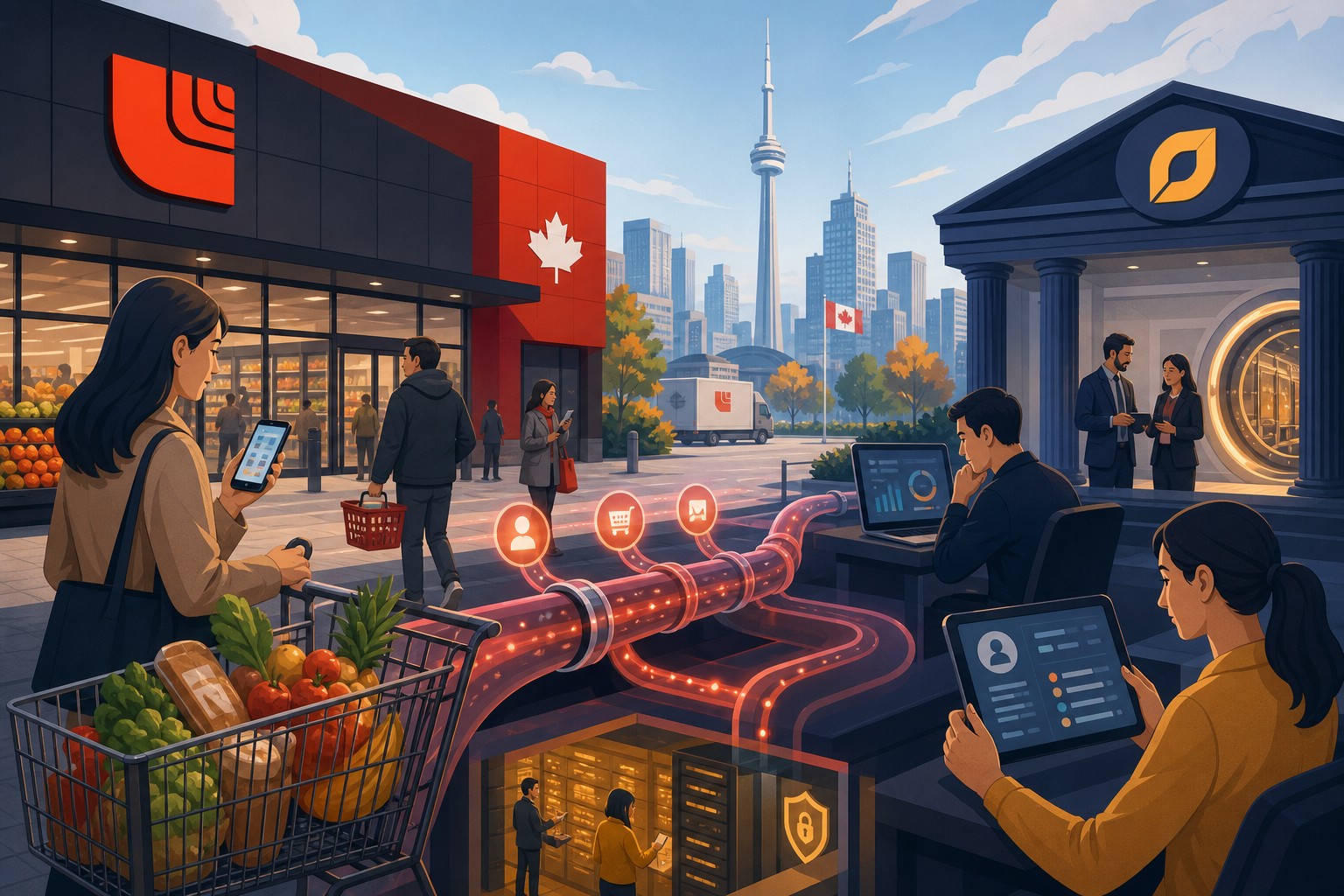

EQB shares climbed 9% in a single session last July on news that seems straightforward until you look at what Loblaw actually gets for the money. The grocery chain disclosed plans to push its ownership stake in Equitable Bank's parent to nearly 25%, and the market read it as a retailer diversifying into finance. That reading misses the point. Loblaw isn't buying exposure to mortgage spreads. It's buying the pipes.
Equitable Bank is Canada's seventh-largest bank by assets and the platform underneath chunks of PC Financial's banking products. The relationship isn't new. What's new is Loblaw treating that relationship less like a vendor contract and more like owned infrastructure. A 25% stake doesn't get you board control, but it gets you something more durable: alignment on product roadmap, priority access to consumer credit data, and the ability to embed financial services so deeply into the loyalty ecosystem that competitors can't easily pry them loose.
The data play nobody wants to name
This isn't about dividends. Loblaw operates over 1,000 retail locations and holds transaction-level data on millions of Canadian households through PC Optimum. Equitable holds their mortgage history, deposit behavior, and credit utilization. Combining those datasets doesn't just improve targeted offers. It changes the underwriting model. A grocery chain that knows a customer's weekly spend, category mix, and purchase consistency has information a traditional credit bureau doesn't. A bank that can layer that onto credit decisions can price risk more accurately than one working off income statements and bureau scores alone.
The 25% threshold matters because it positions Loblaw close to the regulatory ceiling without crossing into "effective control" territory that would trigger stricter capital requirements under the Bank Act. Ownership of widely held banks in Canada caps at 20% for voting shares and 30% for non-voting without ministerial approval. Loblaw is threading that needle. The stake is large enough to matter operationally, small enough to avoid the full regulatory burden of ownership.
Implicit branch network, zero real estate cost
Equitable has no physical branches. Loblaw has 1,000 of them, and they sell milk. The implicit distribution channel here is harder to replicate than anything the Big Six could build. A Scotiabank can open a branch in a strip mall. It cannot turn its branches into places Canadians visit three times a week for reasons unrelated to banking. Loblaw's retail footprint functions as a soft branch network for Equitable's products without the operational cost of staffing teller lines or maintaining vaults. You can't acquire that. You have to own a grocery chain.
Critics will frame this as Loblaw concentrating too much power: the pantry, the pharmacy, a quarter of a national bank. Fair concern. The counterpoint is that Equitable benefits from the backing of Canada's largest food retailer at a time when digital lenders face funding cost pressure and deposit flight risk. A 25% anchor from Loblaw isn't just capital. It's a signal to depositors and wholesale lenders that this bank has a stable, deep-pocketed partner with no plans to exit. That lowers Equitable's cost of funds over time, which it can pass through as better mortgage rates or higher deposit yields. The tight coupling works both ways.
The stock jumped because investors understand what the stake actually buys. Loblaw isn't diversifying. It's vertically integrating the last mile of consumer finance into a system it already controls at the point of sale. The retail-to-banking pipeline isn't a side bet. It's the core logic of customer lifetime value when the average Canadian visits a grocery store 78 times a year and their bank branch twice.
Read Next
The Fed Hold Everyone Expects Will Sink the Dollar Anyway
Realtors Are Walking Away, And the Prenup Surge Tells You Why
Realtors Are Leaving the Industry, and the Numbers Tell You Why
Kelowna Now Ranks First in Canada for Wildfire Risk: What Condo Buyers Need to Verify Before Closing