Turn your mortgage into a wealth-building tool. Smith Manoeuvre strategies, tax-smart planning, and honest math from two Canadian mortgage strategists.
The Hold Is Settled. When Rate Hikes Actually Start Is Not.
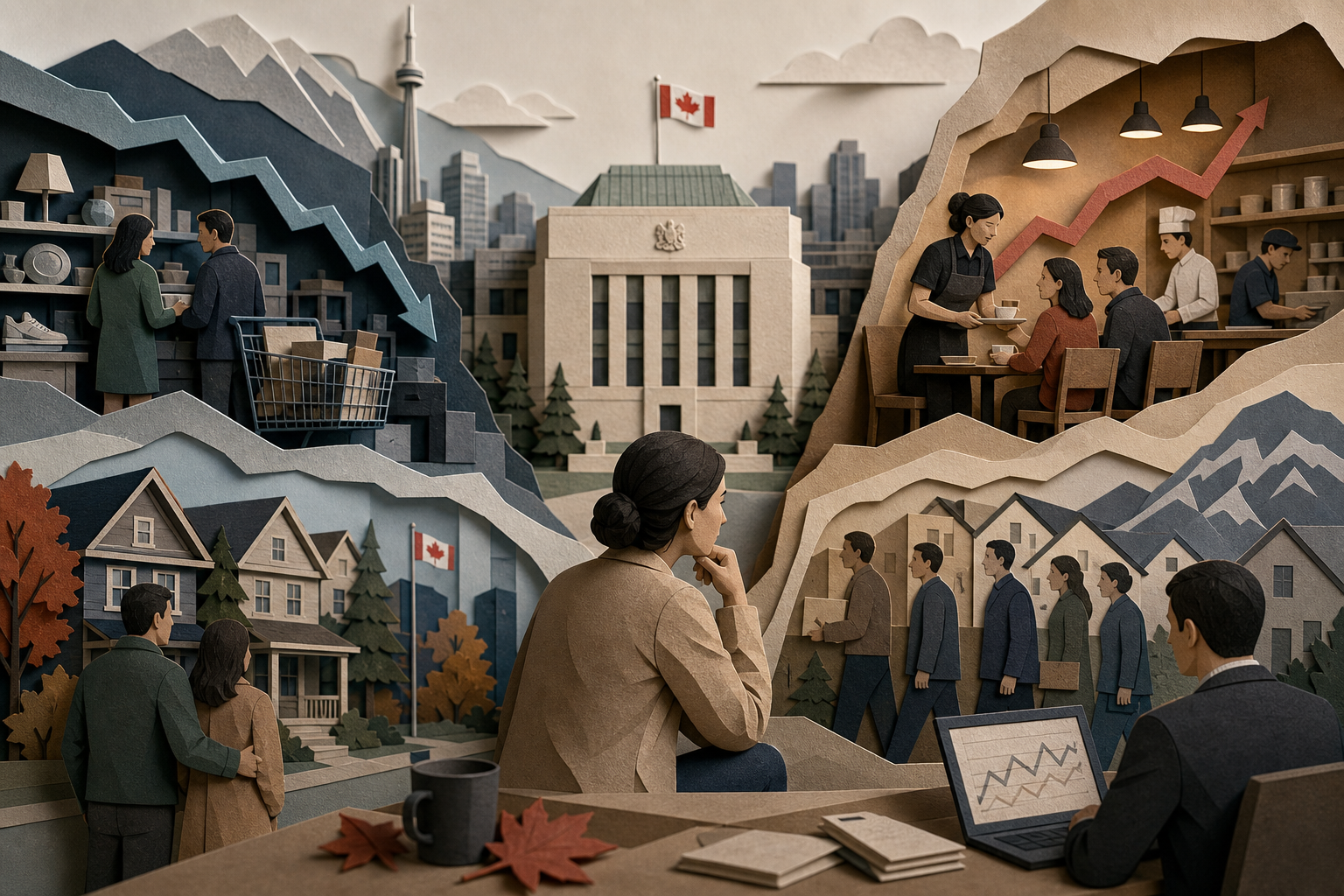
The debate has moved past the July decision. Nobody thinks the Bank of Canada will lift rates from 2.25% this week. Where the split happens is what comes after September.
Two economists, same data, opposite calls. One sees inflation stabilizing within the 1% to 3% band and wages cooling fast enough to justify a hold through year-end. The other sees service-sector inflation stuck above 3%, household debt at 170% of income creating pressure for rate normalization, and the federal spending levels forcing the BoC's hand by Q4. Same CPI prints. Same GDP growth hovering around 1.6%. Different read on what the lag from previous hikes is still doing.
The gap isn't about current conditions. It's about what July's hold implies for the next six meetings.
What the Hold Locks In
At 2.25%, the overnight rate sits in what the BoC calls the "effective lower bound" range for this cycle. That's not the zero-lower-bound crisis language from 2020; it's the level below which cuts would signal a recession call rather than fine-tuning. The hold at 2.25% is the central bank saying inflation is controlled enough to avoid tightening, but not controlled enough to ease.
For mortgage holders renewing in 2026, that floor matters more than the ceiling. A five-year fixed mortgage taken out in May 2021 at 1.59% is rolling into a market where the best rate is 4.89%. On a $450,000 balance, that's a jump from roughly $1,950 per month to $2,630. The monthly payment rise isn't theoretical. It's hitting now.
The BoC knows this. The mortgage renewal wave was baked into the forecasting models two years ago. What wasn't baked in: how much consumer spending would fall as a result, and whether that spending drop would be enough to suppress inflation without further rate action.
Where the Timing Split Comes From
The hawks, calling for a move by November 2026, point to sticky wage growth in healthcare, education, and hospitality. CPI excluding shelter ran 2.1% in June, but that's skewed by goods deflation. Service prices ex-housing are running closer to 3.4%, and wage settlements in the public sector are locking in 3% to 4% annual bumps through 2027. You can't hit 2% inflation with 3.5% wage growth unless productivity surges, and Canadian productivity has been flat for three years.
The doves counter with the labor force survey showing job vacancies down 22% year-over-year and hours worked in retail and wholesale declining for four straight months. Wage growth looks sticky in rear-view data, but the leading indicators, hiring plans, job postings, quit rates, are all pointing to cooling. By their logic, raising rates in November would overtighten into a slowdown the data hasn't confirmed yet.
Both camps agree on one variable: the U.S. Federal Reserve path. If the Fed holds through December, the BoC has room to hold. If the Fed hikes in September citing renewed inflation pressures, the BoC follows within 60 days or risks the Canadian dollar falling below 72 cents USD, which imports inflation through every goods purchase.
The Unpriced Risk
What neither side is modeling clearly: fiscal drag. Federal program spending in Canada remains elevated relative to pre-pandemic baseline, running roughly 2.8% of GDP above the 2015-2019 average. That's deficit-financed demand the BoC can't directly offset without aggressive rate action.
The scenario where the BoC raises rates in Q4 2026 isn't necessarily an inflation-overheating story. It's a fiscal-monetary imbalance story. The central bank tightens not because CPI is spiking, but because fiscal policy won't tighten and someone has to close the demand gap.
That's the version of events where a November hike happens even if headline CPI stays at 2.2%. The rate move becomes the BoC's way of saying we can't do this alone.



The debate has moved past the July decision. Nobody thinks the Bank of Canada will lift rates from 2.25% this week. Where the split happens is what comes after September.
Two economists, same data, opposite calls. One sees inflation stabilizing within the 1% to 3% band and wages cooling fast enough to justify a hold through year-end. The other sees service-sector inflation stuck above 3%, household debt at 170% of income creating pressure for rate normalization, and the federal spending levels forcing the BoC's hand by Q4. Same CPI prints. Same GDP growth hovering around 1.6%. Different read on what the lag from previous hikes is still doing.
The gap isn't about current conditions. It's about what July's hold implies for the next six meetings.
What the Hold Locks In
At 2.25%, the overnight rate sits in what the BoC calls the "effective lower bound" range for this cycle. That's not the zero-lower-bound crisis language from 2020; it's the level below which cuts would signal a recession call rather than fine-tuning. The hold at 2.25% is the central bank saying inflation is controlled enough to avoid tightening, but not controlled enough to ease.
For mortgage holders renewing in 2026, that floor matters more than the ceiling. A five-year fixed mortgage taken out in May 2021 at 1.59% is rolling into a market where the best rate is 4.89%. On a $450,000 balance, that's a jump from roughly $1,950 per month to $2,630. The monthly payment rise isn't theoretical. It's hitting now.
The BoC knows this. The mortgage renewal wave was baked into the forecasting models two years ago. What wasn't baked in: how much consumer spending would fall as a result, and whether that spending drop would be enough to suppress inflation without further rate action.
Where the Timing Split Comes From
The hawks, calling for a move by November 2026, point to sticky wage growth in healthcare, education, and hospitality. CPI excluding shelter ran 2.1% in June, but that's skewed by goods deflation. Service prices ex-housing are running closer to 3.4%, and wage settlements in the public sector are locking in 3% to 4% annual bumps through 2027. You can't hit 2% inflation with 3.5% wage growth unless productivity surges, and Canadian productivity has been flat for three years.
The doves counter with the labor force survey showing job vacancies down 22% year-over-year and hours worked in retail and wholesale declining for four straight months. Wage growth looks sticky in rear-view data, but the leading indicators, hiring plans, job postings, quit rates, are all pointing to cooling. By their logic, raising rates in November would overtighten into a slowdown the data hasn't confirmed yet.
Both camps agree on one variable: the U.S. Federal Reserve path. If the Fed holds through December, the BoC has room to hold. If the Fed hikes in September citing renewed inflation pressures, the BoC follows within 60 days or risks the Canadian dollar falling below 72 cents USD, which imports inflation through every goods purchase.
The Unpriced Risk
What neither side is modeling clearly: fiscal drag. Federal program spending in Canada remains elevated relative to pre-pandemic baseline, running roughly 2.8% of GDP above the 2015-2019 average. That's deficit-financed demand the BoC can't directly offset without aggressive rate action.
The scenario where the BoC raises rates in Q4 2026 isn't necessarily an inflation-overheating story. It's a fiscal-monetary imbalance story. The central bank tightens not because CPI is spiking, but because fiscal policy won't tighten and someone has to close the demand gap.
That's the version of events where a November hike happens even if headline CPI stays at 2.2%. The rate move becomes the BoC's way of saying we can't do this alone.
Read Next
The Fed Hold Everyone Expects Will Sink the Dollar Anyway
Realtors Are Walking Away, And the Prenup Surge Tells You Why
Realtors Are Leaving the Industry, and the Numbers Tell You Why
Kelowna Now Ranks First in Canada for Wildfire Risk: What Condo Buyers Need to Verify Before Closing