Turn your mortgage into a wealth-building tool. Smith Manoeuvre strategies, tax-smart planning, and honest math from two Canadian mortgage strategists.
Trump Sells Tariffs in Michigan While the Gordie Howe Bridge Opens Without Him
The busiest commercial crossing in North America got a new piece of infrastructure this month, designed to move $2.5 billion in daily trade faster. The president who spent years promising to protect Michigan manufacturing skipped the ribbon-cutting.
Donald Trump was in Michigan last week, but not at the Gordie Howe Bridge. He was an hour north in Flint, selling a 25% blanket tariff on Canadian imports as economic patriotism. The bridge opened quietly in Windsor and Detroit, a $6 billion connector built to handle the just-in-time supply chains that Trump's trade policy now threatens to break.
The irony is structural. Michigan moves more goods to Canada than any other state: $85.6 billion in 2023 according to Census Bureau data. Roughly 60% of the state's exports cross into Ontario. The automotive sector, which Trump has positioned himself as defending, runs on a binational assembly line where engines, transmissions, and body panels cross the border two or three times before a truck rolls off the line in Dearborn. A 25% tariff doesn't hit once. It compounds.
The double-tax problem
A Windsor-built engine shipped to a Michigan assembly plant for installation now carries a 25% tariff. If that completed vehicle uses Canadian aluminum in its frame or Ontario-made wiring harnesses, those components were taxed on entry as well. The same part gets taxed every time it crosses. Industry analysts project the full tariff load could add more than $7,000 to the sticker price of a domestically assembled vehicle. That is not a tax on Canada. It is a tax on Michigan.
The administration frames this as leverage. The tariffs are not permanent policy but a negotiating hammer, designed to extract concessions on border enforcement and fentanyl interdiction before the 2026 USMCA review. The argument: make the pain sharp enough and Ottawa folds. The problem with that theory is that Canada has its own political constraints. Retaliatory tariffs, historically aimed at U.S. agricultural exports and consumer goods produced in swing states, are not optional for a Canadian government facing an election. Ottawa matches dollar-for-dollar. It always has.
So Michigan gets hit twice: once on the imports it depends on, and again when Canada targets exports from the state's farmers and manufacturers in retaliation. The Gordie Howe Bridge was supposed to ease congestion at the privately owned Ambassador Bridge and future-proof the Windsor-Detroit corridor. Instead, it opens into a trade war that makes the infrastructure redundant before it is fully operational.
What the ground looks like
The bigger risk is not the bridge. It is Line 5, the Enbridge pipeline that runs under the Straits of Mackinac and supplies a significant share of Michigan's propane and refinery feedstock. That infrastructure is already contested, with environmental groups and the state government pushing for decommissioning. Add a trade conflict that positions Canadian energy as a national security variable, and Line 5's political survival becomes even more precarious. Michigan refineries do not have a ready alternative.
Trump's Flint speech leaned hard on the language of bringing jobs back. The case he made: short-term pain for long-term reshoring. But reshoring is a five-year process involving capital allocation, site selection, and supply chain redesign. A Michigan household refinancing a mortgage this year or a small manufacturer signing contracts for 2026 does not have five years of cushion. They have the price they are paying now.
The bridge is open. The tariffs are real. One was built for connection; the other is a wall with a 25% toll. Michigan is caught in the middle, paying both sides of the bill while the president who promised to protect its factories stayed home from the ceremony.


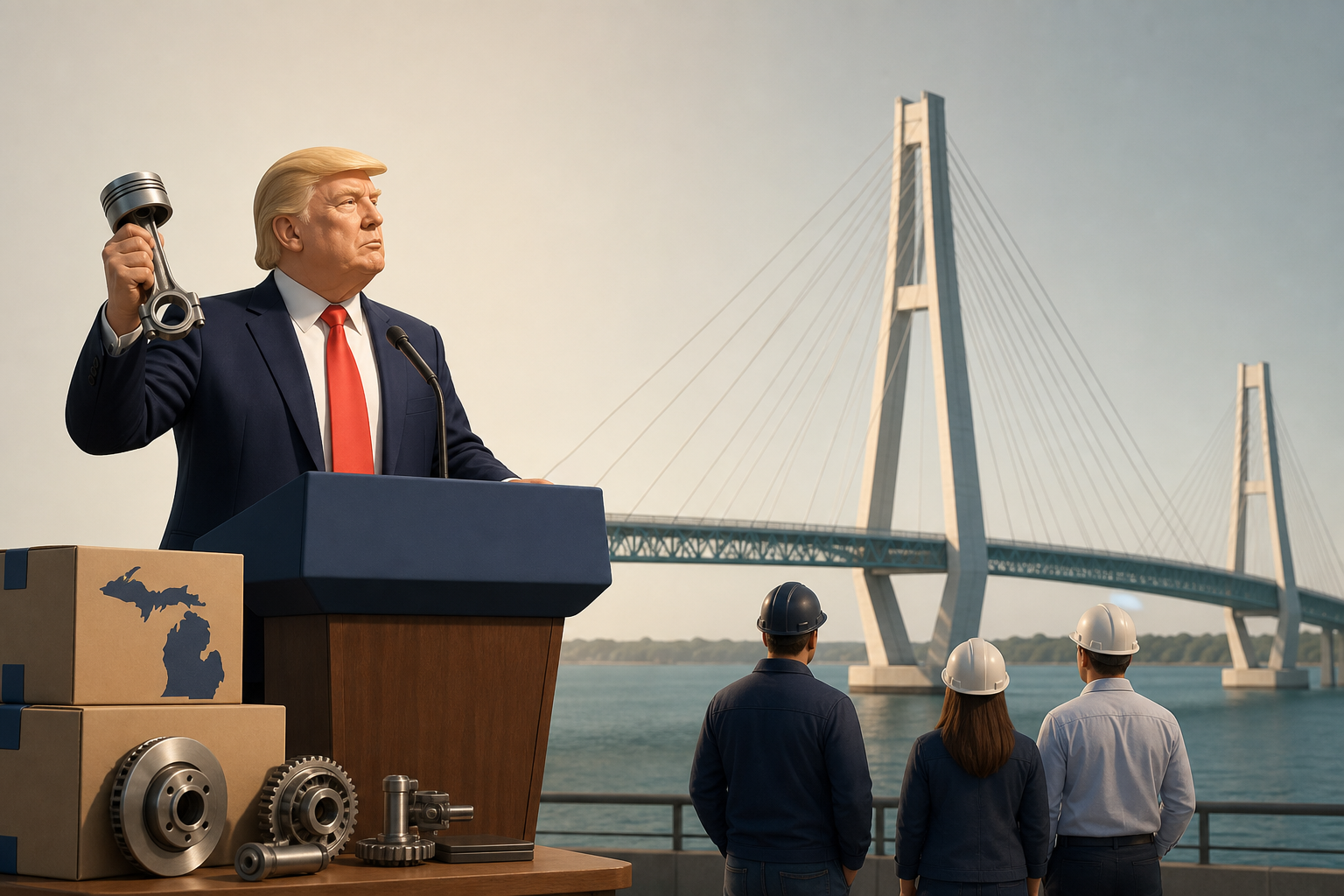

The busiest commercial crossing in North America got a new piece of infrastructure this month, designed to move $2.5 billion in daily trade faster. The president who spent years promising to protect Michigan manufacturing skipped the ribbon-cutting.
Donald Trump was in Michigan last week, but not at the Gordie Howe Bridge. He was an hour north in Flint, selling a 25% blanket tariff on Canadian imports as economic patriotism. The bridge opened quietly in Windsor and Detroit, a $6 billion connector built to handle the just-in-time supply chains that Trump's trade policy now threatens to break.
The irony is structural. Michigan moves more goods to Canada than any other state: $85.6 billion in 2023 according to Census Bureau data. Roughly 60% of the state's exports cross into Ontario. The automotive sector, which Trump has positioned himself as defending, runs on a binational assembly line where engines, transmissions, and body panels cross the border two or three times before a truck rolls off the line in Dearborn. A 25% tariff doesn't hit once. It compounds.
The double-tax problem
A Windsor-built engine shipped to a Michigan assembly plant for installation now carries a 25% tariff. If that completed vehicle uses Canadian aluminum in its frame or Ontario-made wiring harnesses, those components were taxed on entry as well. The same part gets taxed every time it crosses. Industry analysts project the full tariff load could add more than $7,000 to the sticker price of a domestically assembled vehicle. That is not a tax on Canada. It is a tax on Michigan.
The administration frames this as leverage. The tariffs are not permanent policy but a negotiating hammer, designed to extract concessions on border enforcement and fentanyl interdiction before the 2026 USMCA review. The argument: make the pain sharp enough and Ottawa folds. The problem with that theory is that Canada has its own political constraints. Retaliatory tariffs, historically aimed at U.S. agricultural exports and consumer goods produced in swing states, are not optional for a Canadian government facing an election. Ottawa matches dollar-for-dollar. It always has.
So Michigan gets hit twice: once on the imports it depends on, and again when Canada targets exports from the state's farmers and manufacturers in retaliation. The Gordie Howe Bridge was supposed to ease congestion at the privately owned Ambassador Bridge and future-proof the Windsor-Detroit corridor. Instead, it opens into a trade war that makes the infrastructure redundant before it is fully operational.
What the ground looks like
The bigger risk is not the bridge. It is Line 5, the Enbridge pipeline that runs under the Straits of Mackinac and supplies a significant share of Michigan's propane and refinery feedstock. That infrastructure is already contested, with environmental groups and the state government pushing for decommissioning. Add a trade conflict that positions Canadian energy as a national security variable, and Line 5's political survival becomes even more precarious. Michigan refineries do not have a ready alternative.
Trump's Flint speech leaned hard on the language of bringing jobs back. The case he made: short-term pain for long-term reshoring. But reshoring is a five-year process involving capital allocation, site selection, and supply chain redesign. A Michigan household refinancing a mortgage this year or a small manufacturer signing contracts for 2026 does not have five years of cushion. They have the price they are paying now.
The bridge is open. The tariffs are real. One was built for connection; the other is a wall with a 25% toll. Michigan is caught in the middle, paying both sides of the bill while the president who promised to protect its factories stayed home from the ceremony.
Read Next
The Fed Hold Everyone Expects Will Sink the Dollar Anyway
Realtors Are Walking Away, And the Prenup Surge Tells You Why
Realtors Are Leaving the Industry, and the Numbers Tell You Why
Kelowna Now Ranks First in Canada for Wildfire Risk: What Condo Buyers Need to Verify Before Closing