Turn your mortgage into a wealth-building tool. Smith Manoeuvre strategies, tax-smart planning, and honest math from two Canadian mortgage strategists.
Trump's 50% Tariff on Canada Isn't a Negotiating Tactic, It's Economic Warfare
$2.6 billion in goods and services crosses the Canada-U.S. border every day. That's not a talking point. That's the physical volume of an economy so integrated that a part for a Ford F-150 can cross the border seven times before the truck rolls off a Michigan assembly line. A 50% tariff doesn't slow that down. It severs it.
This isn't a negotiating position. Negotiating positions have off-ramps. They come with條件s that, however unreasonable, can theoretically be met. A 50% blanket tariff on Canadian exports has no conditions attached. It's a unilateral decision to end the functional reality of the CUSMA trade agreement two years before its scheduled 2026 review. The mechanism here isn't diplomacy. It's the International Emergency Economic Powers Act, which gives the U.S. President the authority to declare a trade emergency and act accordingly. The emergency being invoked is border security and fentanyl flows, issues that have exactly nothing to do with lumber shipments from British Columbia or auto parts from Ontario.
The arithmetic makes this impossible to survive
Canada sends roughly $450 billion in goods to the U.S. annually. Seventy-five percent of all Canadian exports go south. A 50% tariff is effectively a $225 billion tax on the Canadian economy, paid by both the exporters who eat the margin loss and the American consumers who absorb the price hike. The Canadian government can retaliate dollar-for-dollar, and it will. It always does. In 2018, when Trump imposed steel and aluminum tariffs, Canada responded with targeted countermeasures on bourbon, orange juice, and pork, all sourced from politically sensitive states. This time, the retaliation list will be longer and sharper.
But retaliation doesn't fix the underlying problem. Canada's export base is concentrated in energy, automotive, and raw materials. A 50% tariff on Canadian crude oil, which supplies roughly 60% of U.S. Midwest refineries, doesn't hurt Canada more than it hurts Michigan. It just raises the price of gasoline in Detroit by $1.20 a gallon. A 50% tariff on softwood lumber doesn't protect American forestry jobs that don't exist in sufficient numbers. It raises the cost of building a house in Phoenix by $18,000.
The automotive sector is where this becomes genuinely destructive. The Great Lakes automotive cluster operates as a single production zone. A stamping plant in Windsor supplies eight assembly lines in Ohio and Indiana. A 50% tariff doesn't relocate that plant. It bankrupts the suppliers on both sides of the border who built their operations around tariff-free continental integration. The U.S. auto industry doesn't come out of this stronger. It comes out smaller.
The geopolitical shift is the real target
The 2026 CUSMA review was always going to be contentious. Dairy access, digital services taxes, dispute resolution mechanisms, all of it was teed up for renegotiation. A 50% tariff in 2025 is a pre-negotiation wipeout. It forces Canada to accept terms under duress or begin the work of economic disengagement from the U.S. entirely. That disengagement is not theoretical. Canada is already a member of the CPTPP, the Trans-Pacific trade bloc that includes Japan, Australia, and Vietnam. If the U.S. makes continental trade untenable, Canada will deepen those relationships. The U.S. loses its guaranteed access to Canadian energy, minerals, and the northern logistics corridor it relies on for Arctic security.
The phrasing matters here. This isn't being sold as a renegotiation lever. It's being implemented as policy. The difference is that levers get pulled back. Policies get embedded. Once a 50% tariff goes live, the compliance infrastructure, the supply chain reconfigurations, and the retaliatory frameworks all become permanent. Rolling it back would require admitting the policy failed, and that's not something this administration does.
So what you're looking at is the dismantling of a 30-year continental economic framework in favor of a doctrine that treats trade as a zero-sum resource extraction game. Canada doesn't win that game. But neither does the U.S. Midwest, which just got $225 billion poorer.


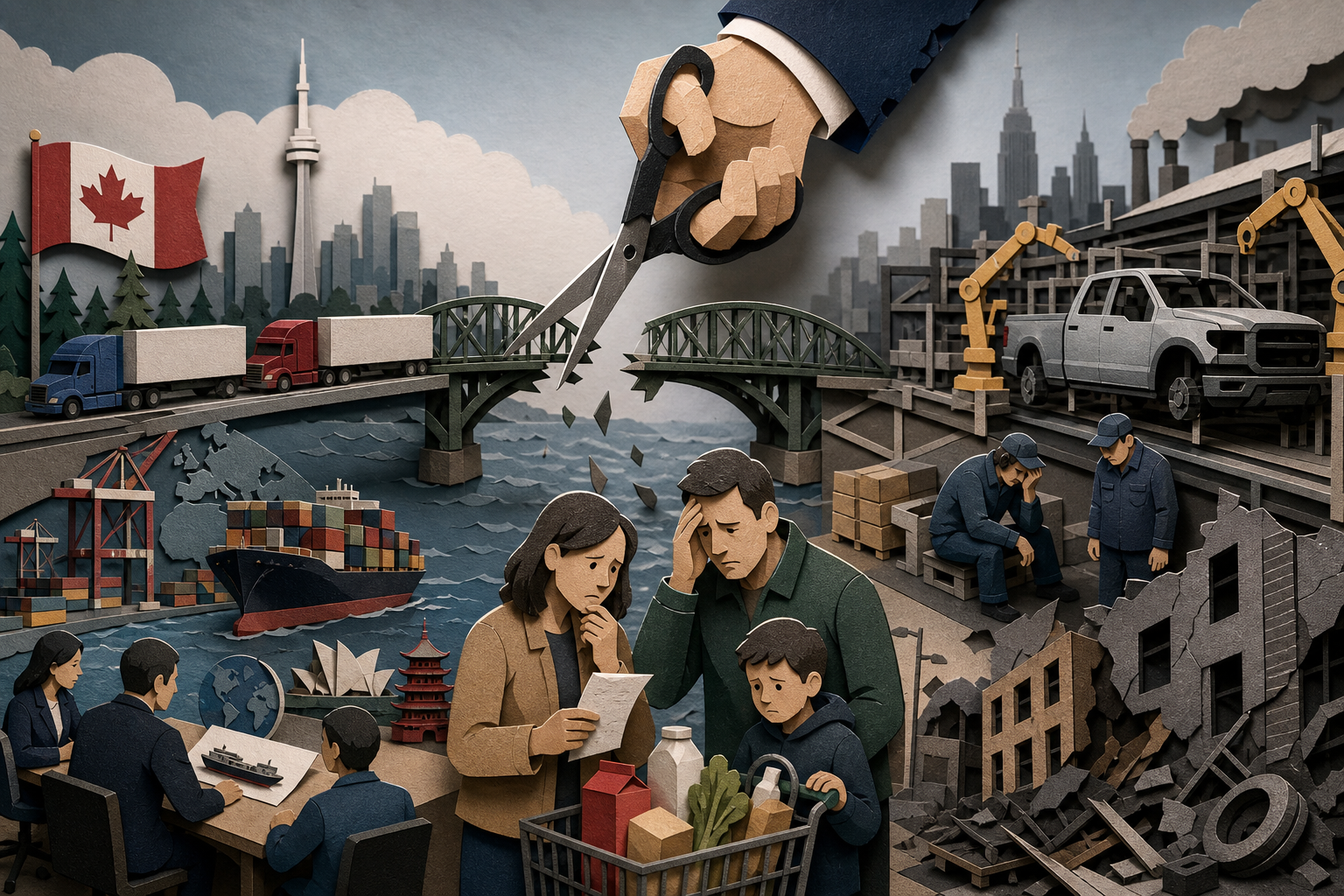

$2.6 billion in goods and services crosses the Canada-U.S. border every day. That's not a talking point. That's the physical volume of an economy so integrated that a part for a Ford F-150 can cross the border seven times before the truck rolls off a Michigan assembly line. A 50% tariff doesn't slow that down. It severs it.
This isn't a negotiating position. Negotiating positions have off-ramps. They come with條件s that, however unreasonable, can theoretically be met. A 50% blanket tariff on Canadian exports has no conditions attached. It's a unilateral decision to end the functional reality of the CUSMA trade agreement two years before its scheduled 2026 review. The mechanism here isn't diplomacy. It's the International Emergency Economic Powers Act, which gives the U.S. President the authority to declare a trade emergency and act accordingly. The emergency being invoked is border security and fentanyl flows, issues that have exactly nothing to do with lumber shipments from British Columbia or auto parts from Ontario.
The arithmetic makes this impossible to survive
Canada sends roughly $450 billion in goods to the U.S. annually. Seventy-five percent of all Canadian exports go south. A 50% tariff is effectively a $225 billion tax on the Canadian economy, paid by both the exporters who eat the margin loss and the American consumers who absorb the price hike. The Canadian government can retaliate dollar-for-dollar, and it will. It always does. In 2018, when Trump imposed steel and aluminum tariffs, Canada responded with targeted countermeasures on bourbon, orange juice, and pork, all sourced from politically sensitive states. This time, the retaliation list will be longer and sharper.
But retaliation doesn't fix the underlying problem. Canada's export base is concentrated in energy, automotive, and raw materials. A 50% tariff on Canadian crude oil, which supplies roughly 60% of U.S. Midwest refineries, doesn't hurt Canada more than it hurts Michigan. It just raises the price of gasoline in Detroit by $1.20 a gallon. A 50% tariff on softwood lumber doesn't protect American forestry jobs that don't exist in sufficient numbers. It raises the cost of building a house in Phoenix by $18,000.
The automotive sector is where this becomes genuinely destructive. The Great Lakes automotive cluster operates as a single production zone. A stamping plant in Windsor supplies eight assembly lines in Ohio and Indiana. A 50% tariff doesn't relocate that plant. It bankrupts the suppliers on both sides of the border who built their operations around tariff-free continental integration. The U.S. auto industry doesn't come out of this stronger. It comes out smaller.
The geopolitical shift is the real target
The 2026 CUSMA review was always going to be contentious. Dairy access, digital services taxes, dispute resolution mechanisms, all of it was teed up for renegotiation. A 50% tariff in 2025 is a pre-negotiation wipeout. It forces Canada to accept terms under duress or begin the work of economic disengagement from the U.S. entirely. That disengagement is not theoretical. Canada is already a member of the CPTPP, the Trans-Pacific trade bloc that includes Japan, Australia, and Vietnam. If the U.S. makes continental trade untenable, Canada will deepen those relationships. The U.S. loses its guaranteed access to Canadian energy, minerals, and the northern logistics corridor it relies on for Arctic security.
The phrasing matters here. This isn't being sold as a renegotiation lever. It's being implemented as policy. The difference is that levers get pulled back. Policies get embedded. Once a 50% tariff goes live, the compliance infrastructure, the supply chain reconfigurations, and the retaliatory frameworks all become permanent. Rolling it back would require admitting the policy failed, and that's not something this administration does.
So what you're looking at is the dismantling of a 30-year continental economic framework in favor of a doctrine that treats trade as a zero-sum resource extraction game. Canada doesn't win that game. But neither does the U.S. Midwest, which just got $225 billion poorer.
Read Next
The Fed Hold Everyone Expects Will Sink the Dollar Anyway
Realtors Are Walking Away, And the Prenup Surge Tells You Why
Realtors Are Leaving the Industry, and the Numbers Tell You Why
Kelowna Now Ranks First in Canada for Wildfire Risk: What Condo Buyers Need to Verify Before Closing