Turn your mortgage into a wealth-building tool. Smith Manoeuvre strategies, tax-smart planning, and honest math from two Canadian mortgage strategists.
What a Frank Lloyd Wright Protégé Actually Adds to a $2M Toronto Property
The residence at 2 Ledge Road occupies a half-acre ravine lot overlooking Lake Ontario, with sightlines that run unobstructed from a southeast-facing orientation that was calculated, not stumbled upon. The asking price is $1,999,999. In the context of Toronto's E08 district, where detached homes on standard 30-to-50-foot lots now trade in the $1.5M to $2.2M range, the price reads less like a premium for architecture and more like an acknowledgment that what you're buying is the land itself, plus permission not to bulldoze what sits on it.
What the Wright lineage actually delivers here isn't style. It's constraint. The home was designed by an apprentice trained in "organic architecture," which is the formal term for a design philosophy that subordinates the building to its site. Flat rooflines, natural materials (wood, stone), and glass expanses positioned to minimize visual intrusion on the ravine, these are structural commitments, not aesthetic flourishes. The house was built to disappear into the landscape, which means any future owner contemplating a 5,000-square-foot rebuild is fighting the lot's entire reason for being.
The Unbuildable Premium
Half an acre inside Toronto city limits is a statistical rarity, but scarcity alone doesn't drive value if you can't use the land. Properties along the Scarborough Bluffs fall under the jurisdiction of the Toronto and Region Conservation Authority (TRCA), which imposes setback requirements from the bluff's edge to protect against erosion. That regulation turns portions of large lots into unbuildable zones, regardless of what you own on paper. The architecture in this case was designed around that constraint from the beginning, which means the footprint you're inheriting is close to the maximum you'll ever get.
Buyers thinking of this as a teardown should run the math on what they'd actually be permitted to build. In most cases, the answer is: not much more than what's already there, and at a higher cost per square foot than the current structure.
The Maintenance Floor
Mid-century homes with flat roofs and floor-to-ceiling glass require specialized upkeep. Flat roofs leak. They require membrane replacement every 20 to 25 years, and the process is neither cheap nor forgiving of delays. Large glass expanses, when original to a 1960s build, perform poorly by 2026 energy standards unless retrofitted. The heating bill on a ravine-exposed home with single-pane glass can run into four figures monthly during Toronto winters. Retrofitting without destroying the architectural intent is possible but expensive, and most contractors who specialize in energy-efficient retrofits do not specialize in preserving mid-century design language.
What you're buying, in other words, includes a commitment to ongoing maintenance costs that are higher than a comparable square footage in a conventional suburban build. The architecture doesn't just sit there. It requires you to care about it, or it degrades.
Scarcity That Stays Scarce
The deeper value proposition is positional. Cliffcrest has transformed from a sleepy suburban pocket into a high-end alternative to the Beaches, offering larger lots and more dramatic topography at a lower price per square foot. A property this secluded, nestled at the end of a private road, surrounded by mature trees, with no visible neighbors from the main living spaces, reads as "cottage country" more than "city residence." In 2026, with hybrid work arrangements cemented and commute tolerance collapsed, the ability to live in functional isolation without leaving the 416 area code has outpaced demand for distant recreational properties.
The Wright pedigree doesn't inflate the price. It protects a certain kind of buyer from themselves. The architecture locks in a use case: you will live in this landscape, not dominate it. That constraint, for the subset of buyers who want it, is worth more than flexibility.


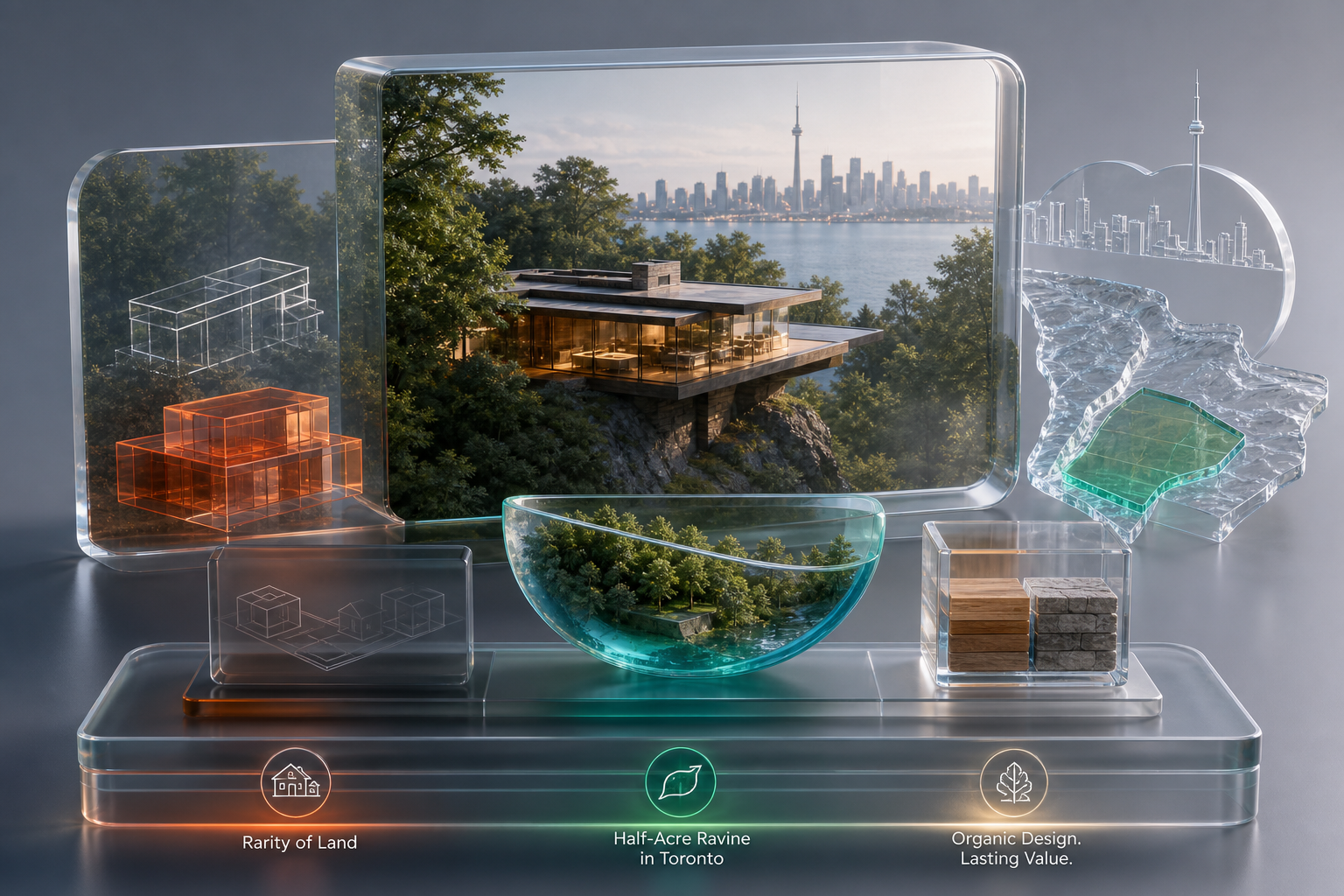

The residence at 2 Ledge Road occupies a half-acre ravine lot overlooking Lake Ontario, with sightlines that run unobstructed from a southeast-facing orientation that was calculated, not stumbled upon. The asking price is $1,999,999. In the context of Toronto's E08 district, where detached homes on standard 30-to-50-foot lots now trade in the $1.5M to $2.2M range, the price reads less like a premium for architecture and more like an acknowledgment that what you're buying is the land itself, plus permission not to bulldoze what sits on it.
What the Wright lineage actually delivers here isn't style. It's constraint. The home was designed by an apprentice trained in "organic architecture," which is the formal term for a design philosophy that subordinates the building to its site. Flat rooflines, natural materials (wood, stone), and glass expanses positioned to minimize visual intrusion on the ravine, these are structural commitments, not aesthetic flourishes. The house was built to disappear into the landscape, which means any future owner contemplating a 5,000-square-foot rebuild is fighting the lot's entire reason for being.
The Unbuildable Premium
Half an acre inside Toronto city limits is a statistical rarity, but scarcity alone doesn't drive value if you can't use the land. Properties along the Scarborough Bluffs fall under the jurisdiction of the Toronto and Region Conservation Authority (TRCA), which imposes setback requirements from the bluff's edge to protect against erosion. That regulation turns portions of large lots into unbuildable zones, regardless of what you own on paper. The architecture in this case was designed around that constraint from the beginning, which means the footprint you're inheriting is close to the maximum you'll ever get.
Buyers thinking of this as a teardown should run the math on what they'd actually be permitted to build. In most cases, the answer is: not much more than what's already there, and at a higher cost per square foot than the current structure.
The Maintenance Floor
Mid-century homes with flat roofs and floor-to-ceiling glass require specialized upkeep. Flat roofs leak. They require membrane replacement every 20 to 25 years, and the process is neither cheap nor forgiving of delays. Large glass expanses, when original to a 1960s build, perform poorly by 2026 energy standards unless retrofitted. The heating bill on a ravine-exposed home with single-pane glass can run into four figures monthly during Toronto winters. Retrofitting without destroying the architectural intent is possible but expensive, and most contractors who specialize in energy-efficient retrofits do not specialize in preserving mid-century design language.
What you're buying, in other words, includes a commitment to ongoing maintenance costs that are higher than a comparable square footage in a conventional suburban build. The architecture doesn't just sit there. It requires you to care about it, or it degrades.
Scarcity That Stays Scarce
The deeper value proposition is positional. Cliffcrest has transformed from a sleepy suburban pocket into a high-end alternative to the Beaches, offering larger lots and more dramatic topography at a lower price per square foot. A property this secluded, nestled at the end of a private road, surrounded by mature trees, with no visible neighbors from the main living spaces, reads as "cottage country" more than "city residence." In 2026, with hybrid work arrangements cemented and commute tolerance collapsed, the ability to live in functional isolation without leaving the 416 area code has outpaced demand for distant recreational properties.
The Wright pedigree doesn't inflate the price. It protects a certain kind of buyer from themselves. The architecture locks in a use case: you will live in this landscape, not dominate it. That constraint, for the subset of buyers who want it, is worth more than flexibility.
Read Next
The Fed Hold Everyone Expects Will Sink the Dollar Anyway
Realtors Are Walking Away, And the Prenup Surge Tells You Why
Realtors Are Leaving the Industry, and the Numbers Tell You Why
Kelowna Now Ranks First in Canada for Wildfire Risk: What Condo Buyers Need to Verify Before Closing