Turn your mortgage into a wealth-building tool. Smith Manoeuvre strategies, tax-smart planning, and honest math from two Canadian mortgage strategists.
When a Paramedic Dies Crossing Provincial Lines, Who Is Responsible for Safety?
The Confederation Bridge stretches just over twelve kilometers between Prince Edward Island and New Brunswick, a concrete ribbon that makes P.E.I. paramedics part of a healthcare corridor they don't control. In July 2024, a 56-year-old Island EMS paramedic died in a collision with a transport truck on New Brunswick soil while working a shift that had taken him across provincial lines. The truck driver walked away. The paramedic did not.
The incident triggered the familiar rituals: Last Call tributes, grief counselors dispatched to stations across both provinces, flowers at the ambulance bay. But it also exposed a fracture in the way Canada organizes first-responder safety when the work itself routinely crosses jurisdictions. The paramedic wasn't responding to an emergency scene when he died. He was on the highway, doing the part of the job nobody talks about until someone gets killed doing it.
The Work Nobody Sees
Prince Edward Island has no trauma center. It has no cardiac catheterization lab. For patients who need those services, the protocol is simple: load them into an ambulance and drive them to Moncton or Saint John. Island EMS, the sole ground ambulance provider on P.E.I., employs roughly 200 to 250 paramedics, and a significant portion of their working hours are spent ferrying patients across the bridge into New Brunswick. The distance from Charlottetown to the Moncton Hospital is about 160 kilometers. In winter, when roads ice over, that trip can take close to three hours each way.
The public image of paramedic danger is sharper: violent patients, infectious disease, the chaos of a multi-vehicle pileup. The actual leading cause of line-of-duty death among Canadian paramedics is vehicle collision. According to data tracked by Public Safety Canada, paramedics face workplace injury rates significantly higher than the general population, and vehicle incidents represent the largest single category. The risk doesn't come from lights and sirens. It comes from the cumulative exposure: thousands of kilometers on shared highways, often at night, frequently in weather that would keep most drivers off the road entirely.
The 2024 crash occurred on a Tuesday. The ambulance was involved in a two-vehicle collision with a commercial transport truck. Transport Canada data from 2022 and 2023 shows that trucks are involved in roughly 18 to 20 percent of all road fatalities in Canada, despite representing a much smaller share of registered vehicles. The mass disparity between a transport truck and even a heavy-duty Type III ambulance creates what crash investigators call a "survivability gap." In a collision between the two, the ambulance crew absorbs nearly all the kinetic energy.
The Jurisdictional Seam
Here is the structural problem: Island EMS is regulated and funded by Prince Edward Island. WorkSafe PEI oversees its workplace safety obligations. But the moment a P.E.I. ambulance crosses the Confederation Bridge, it is operating on New Brunswick highways under New Brunswick traffic law, investigated by the RCMP's New Brunswick division, and subject to WorkSafeNB's jurisdiction if a workplace injury occurs. The paramedic who died was employed by a P.E.I. organization, working a P.E.I. shift, transporting a P.E.I. patient. He was killed on a New Brunswick road.
This is not a hypothetical edge case. It is the operating condition for maritime healthcare. The Atlantic provinces depend on each other's specialized services. Nova Scotia sends cardiac patients to Halifax from Cape Breton. New Brunswick transfers burns to Saint John. P.E.I. sends trauma and stroke cases across the bridge. The system works as long as nobody asks who is accountable for the safety of the people doing the transferring.
When the crash occurred, New Brunswick law enforcement handled the scene. New Brunswick's coroner will likely conduct the death investigation. If the paramedic's family pursues a workers' compensation claim, it will go through WorkSafe PEI, not WorkSafeNB, because the employer is Island EMS. But the road design, the truck safety enforcement, the speed limits, and the highway maintenance standards that shaped the conditions of the crash are all New Brunswick's responsibility. The families of first responders killed in cross-border transfers are left navigating two separate regulatory systems that were never designed to coordinate.
The Cost of Institutional Knowledge
The paramedic who died was 56. In a profession with a median age in the low thirties and a burnout rate high enough that many leave within their first five years, a paramedic in their mid-fifties represents something rare: continuity. Island EMS is a small service. At 200 to 250 staff, everyone knows everyone. The loss of a senior member is not just a personnel gap. It is the loss of the person who trained half the current roster, who knew which doctors at which hospitals would actually return a radio call, who could talk a rookie through their first pediatric code without making them feel like they were drowning.
The grief extended across both provinces. New Brunswick paramedics, fire services, and police detachments issued statements. The funeral drew first responders from across the Maritimes. This is the other rarely discussed aspect of these incidents: the psychological load. Post-Traumatic Stress Injury protocols in Canada now classify the death of a colleague as a "critical incident" requiring mandatory debriefing. The entire Island EMS roster was exposed to that trigger simultaneously.
What the Survivors Inherit
In the months following a line-of-duty death, the profession closes ranks. There are fundraisers, memorial patches, scholarship funds. What does not typically follow is a structural change to how interprovincial transfers are conducted. The risks that killed the paramedic in July 2024 remain in place. Island EMS still sends crews across the bridge to Moncton. The Confederation Bridge still funnels all P.E.I.-to-mainland traffic through a single highway corridor. Transport trucks still share that corridor with ambulances. The jurisdictional seam still exists.
Paramedics know this. They know the most dangerous part of their shift is often the part that happens at highway speed with no lights, no sirens, and no public watching. They know that if they go down in New Brunswick while working for a P.E.I. service, the accountability framework will be split across two provinces with no clear mechanism for coordination. They go anyway, because the patient in the back needs the hospital in Moncton, and there is no other way to get them there.
The question the title asks is not rhetorical. When a paramedic dies crossing provincial lines, the answer to "who is responsible for safety" is currently: no one, fully. P.E.I. controls the employment. New Brunswick controls the road. The patient needs both. The system runs on the assumption that the seam will hold. When it doesn't, the survivors are left negotiating a fracture that was always there but only becomes visible in the aftermath.


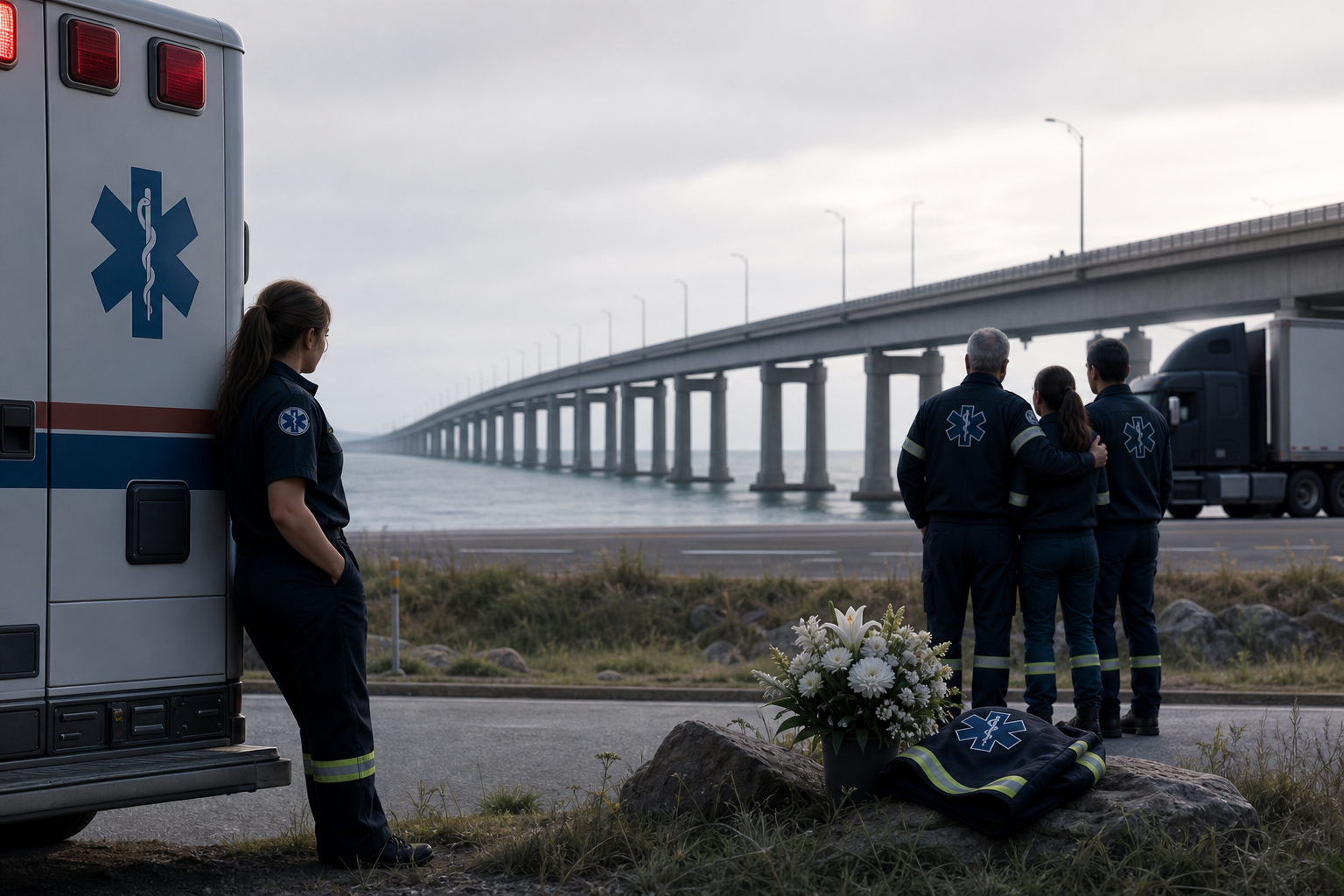

The Confederation Bridge stretches just over twelve kilometers between Prince Edward Island and New Brunswick, a concrete ribbon that makes P.E.I. paramedics part of a healthcare corridor they don't control. In July 2024, a 56-year-old Island EMS paramedic died in a collision with a transport truck on New Brunswick soil while working a shift that had taken him across provincial lines. The truck driver walked away. The paramedic did not.
The incident triggered the familiar rituals: Last Call tributes, grief counselors dispatched to stations across both provinces, flowers at the ambulance bay. But it also exposed a fracture in the way Canada organizes first-responder safety when the work itself routinely crosses jurisdictions. The paramedic wasn't responding to an emergency scene when he died. He was on the highway, doing the part of the job nobody talks about until someone gets killed doing it.
The Work Nobody Sees
Prince Edward Island has no trauma center. It has no cardiac catheterization lab. For patients who need those services, the protocol is simple: load them into an ambulance and drive them to Moncton or Saint John. Island EMS, the sole ground ambulance provider on P.E.I., employs roughly 200 to 250 paramedics, and a significant portion of their working hours are spent ferrying patients across the bridge into New Brunswick. The distance from Charlottetown to the Moncton Hospital is about 160 kilometers. In winter, when roads ice over, that trip can take close to three hours each way.
The public image of paramedic danger is sharper: violent patients, infectious disease, the chaos of a multi-vehicle pileup. The actual leading cause of line-of-duty death among Canadian paramedics is vehicle collision. According to data tracked by Public Safety Canada, paramedics face workplace injury rates significantly higher than the general population, and vehicle incidents represent the largest single category. The risk doesn't come from lights and sirens. It comes from the cumulative exposure: thousands of kilometers on shared highways, often at night, frequently in weather that would keep most drivers off the road entirely.
The 2024 crash occurred on a Tuesday. The ambulance was involved in a two-vehicle collision with a commercial transport truck. Transport Canada data from 2022 and 2023 shows that trucks are involved in roughly 18 to 20 percent of all road fatalities in Canada, despite representing a much smaller share of registered vehicles. The mass disparity between a transport truck and even a heavy-duty Type III ambulance creates what crash investigators call a "survivability gap." In a collision between the two, the ambulance crew absorbs nearly all the kinetic energy.
The Jurisdictional Seam
Here is the structural problem: Island EMS is regulated and funded by Prince Edward Island. WorkSafe PEI oversees its workplace safety obligations. But the moment a P.E.I. ambulance crosses the Confederation Bridge, it is operating on New Brunswick highways under New Brunswick traffic law, investigated by the RCMP's New Brunswick division, and subject to WorkSafeNB's jurisdiction if a workplace injury occurs. The paramedic who died was employed by a P.E.I. organization, working a P.E.I. shift, transporting a P.E.I. patient. He was killed on a New Brunswick road.
This is not a hypothetical edge case. It is the operating condition for maritime healthcare. The Atlantic provinces depend on each other's specialized services. Nova Scotia sends cardiac patients to Halifax from Cape Breton. New Brunswick transfers burns to Saint John. P.E.I. sends trauma and stroke cases across the bridge. The system works as long as nobody asks who is accountable for the safety of the people doing the transferring.
When the crash occurred, New Brunswick law enforcement handled the scene. New Brunswick's coroner will likely conduct the death investigation. If the paramedic's family pursues a workers' compensation claim, it will go through WorkSafe PEI, not WorkSafeNB, because the employer is Island EMS. But the road design, the truck safety enforcement, the speed limits, and the highway maintenance standards that shaped the conditions of the crash are all New Brunswick's responsibility. The families of first responders killed in cross-border transfers are left navigating two separate regulatory systems that were never designed to coordinate.
The Cost of Institutional Knowledge
The paramedic who died was 56. In a profession with a median age in the low thirties and a burnout rate high enough that many leave within their first five years, a paramedic in their mid-fifties represents something rare: continuity. Island EMS is a small service. At 200 to 250 staff, everyone knows everyone. The loss of a senior member is not just a personnel gap. It is the loss of the person who trained half the current roster, who knew which doctors at which hospitals would actually return a radio call, who could talk a rookie through their first pediatric code without making them feel like they were drowning.
The grief extended across both provinces. New Brunswick paramedics, fire services, and police detachments issued statements. The funeral drew first responders from across the Maritimes. This is the other rarely discussed aspect of these incidents: the psychological load. Post-Traumatic Stress Injury protocols in Canada now classify the death of a colleague as a "critical incident" requiring mandatory debriefing. The entire Island EMS roster was exposed to that trigger simultaneously.
What the Survivors Inherit
In the months following a line-of-duty death, the profession closes ranks. There are fundraisers, memorial patches, scholarship funds. What does not typically follow is a structural change to how interprovincial transfers are conducted. The risks that killed the paramedic in July 2024 remain in place. Island EMS still sends crews across the bridge to Moncton. The Confederation Bridge still funnels all P.E.I.-to-mainland traffic through a single highway corridor. Transport trucks still share that corridor with ambulances. The jurisdictional seam still exists.
Paramedics know this. They know the most dangerous part of their shift is often the part that happens at highway speed with no lights, no sirens, and no public watching. They know that if they go down in New Brunswick while working for a P.E.I. service, the accountability framework will be split across two provinces with no clear mechanism for coordination. They go anyway, because the patient in the back needs the hospital in Moncton, and there is no other way to get them there.
The question the title asks is not rhetorical. When a paramedic dies crossing provincial lines, the answer to "who is responsible for safety" is currently: no one, fully. P.E.I. controls the employment. New Brunswick controls the road. The patient needs both. The system runs on the assumption that the seam will hold. When it doesn't, the survivors are left negotiating a fracture that was always there but only becomes visible in the aftermath.
Read Next
The Fed Hold Everyone Expects Will Sink the Dollar Anyway
Realtors Are Walking Away, And the Prenup Surge Tells You Why
Realtors Are Leaving the Industry, and the Numbers Tell You Why
Kelowna Now Ranks First in Canada for Wildfire Risk: What Condo Buyers Need to Verify Before Closing