Turn your mortgage into a wealth-building tool. Smith Manoeuvre strategies, tax-smart planning, and honest math from two Canadian mortgage strategists.
Why The Bank Of Canada Held Rates At 2.25% Despite Mixed Signals On Recovery
GDP grew at 2.5% in Q2 2026. Unemployment stayed flat at 6.5%. The Bank of Canada looked at both numbers on July 15 and decided the first one mattered more.
That decision, holding the overnight rate at 2.25% rather than cutting further, marks a real shift in how the Bank is reading the economy. For the past eighteen months, every policy statement has been about managing the downside: cooling inflation without tipping into recession, threading the needle between price stability and labour-market damage. The July hold is the first time since early 2024 the Bank has explicitly said "we're worried about reigniting growth problems if we cut too far" instead of "we're still watching for cracks."
The framing matters because the two indicators are telling opposite stories.
The Labour Market Hasn't Moved
Unemployment has been locked in a 6.3% to 6.7% band since November 2024. It's not climbing, which would signal deterioration, but it's also not falling, which would suggest the kind of broad-based recovery the Bank likes to see before declaring victory. The June figure of 6.5% sits exactly in the middle of that range. For workers, this feels like stagnation. For policymakers, it's stability, and stability, after the volatility of 2023 and 2024, counts as progress.
But a 2.5% GDP growth rate with no corresponding drop in unemployment suggests something structural. Either productivity is driving the gains (output per worker rising without new hires), or growth is concentrated in capital-intensive sectors that don't move the employment needle. Neither is bad, exactly. But neither produces the kind of recovery that feels like recovery to someone looking for work in Winnipeg or Hamilton.
Why The Bank Chose Growth Over Employment
The Governing Council's statement pointed to "early signs of a broadening economic recovery" as the rationale for holding. That phrase, broadening, is doing real work. It signals the Bank believes Q2 growth wasn't just a one-sector anomaly or a short-term bounce. Policymakers are betting that 2.5% growth, even with a soft labour market, represents the start of something sustainable rather than a relief rally after a rough 2025.
The alternative would have been another cut. Rates came down significantly from the 2023-2024 peak, and at 2.25%, the overnight rate sits well above the lows of the 2010s but below the "neutral" range the Bank has historically estimated at 2.5% to 3.5%. Cutting further would have signaled the Bank sees downside risks as larger than upside ones. Holding signals the opposite: that the risks now tilt toward reigniting demand too quickly and losing control of inflation again.
That's a judgment call, and it's one the Bank is making with incomplete information. Tariffs and trade uncertainty, both mentioned in the statement, remain unresolved. Slower population growth, a direct result of federal policy changes in 2024 and 2025 capping temporary resident permits, is still filtering through consumption and housing demand. The labour market's stickiness could be a lagging indicator that improves in Q3, or it could be a signal that the recovery isn't as broad as GDP suggests.
The hold also reflects something the Bank won't say explicitly: household debt levels across Canada make the neutral rate unusually sensitive. Even small moves in either direction hit harder when the average mortgage holder is carrying six figures of principal. The 2.25% rate might not be stimulative, but it's also not restrictive in a way that forces another wave of renewals into payment shock. Holding keeps the Bank optionality without destabilizing a housing market that's only recently stopped feeling fragile.
What the July decision really signals is that the Bank has decided the downside-protection phase is over. Whether the recovery proves broad enough to justify that call is a question for Q3 data. But for now, policymakers are betting on the 2.5% figure, not the 6.5% one.


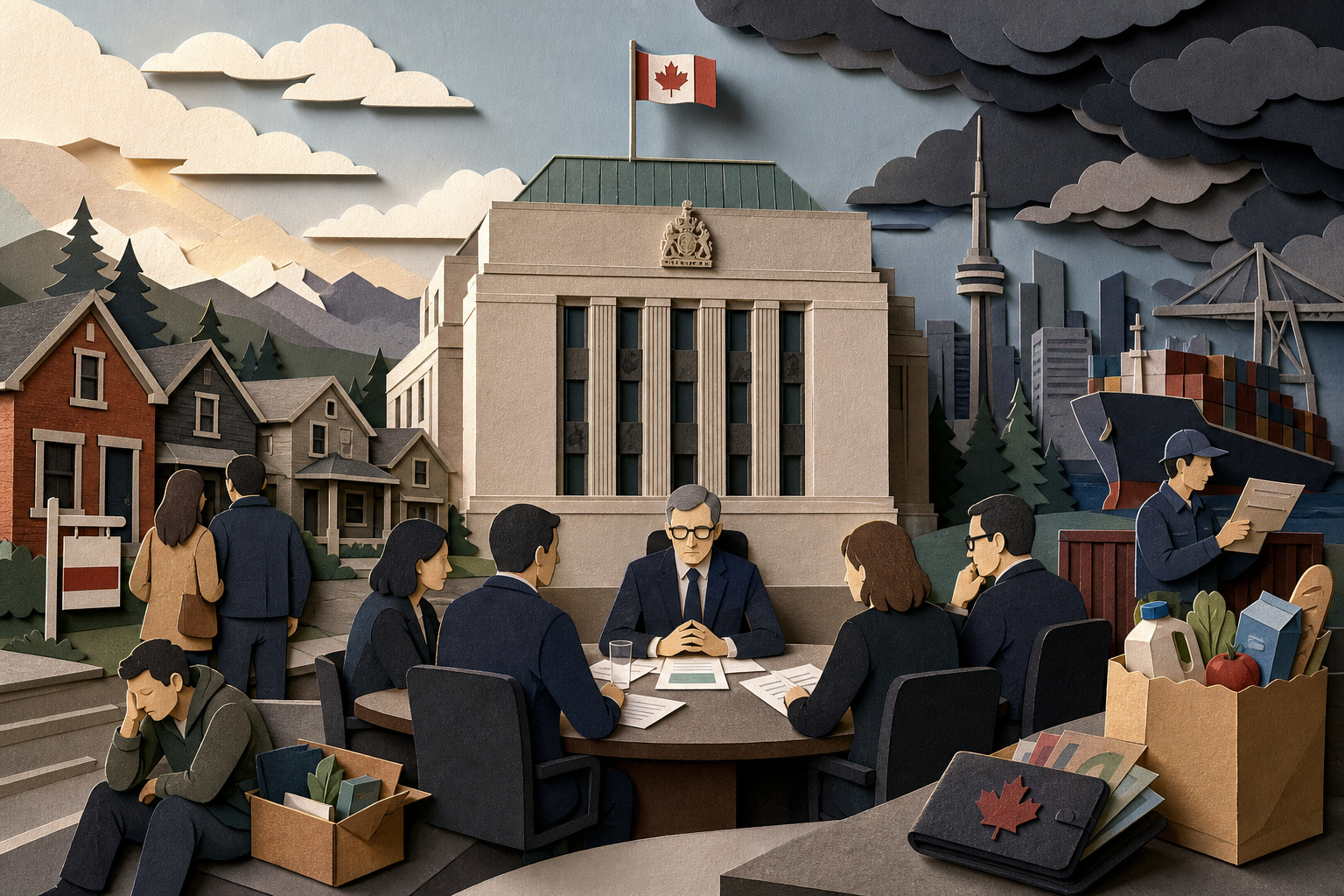

GDP grew at 2.5% in Q2 2026. Unemployment stayed flat at 6.5%. The Bank of Canada looked at both numbers on July 15 and decided the first one mattered more.
That decision, holding the overnight rate at 2.25% rather than cutting further, marks a real shift in how the Bank is reading the economy. For the past eighteen months, every policy statement has been about managing the downside: cooling inflation without tipping into recession, threading the needle between price stability and labour-market damage. The July hold is the first time since early 2024 the Bank has explicitly said "we're worried about reigniting growth problems if we cut too far" instead of "we're still watching for cracks."
The framing matters because the two indicators are telling opposite stories.
The Labour Market Hasn't Moved
Unemployment has been locked in a 6.3% to 6.7% band since November 2024. It's not climbing, which would signal deterioration, but it's also not falling, which would suggest the kind of broad-based recovery the Bank likes to see before declaring victory. The June figure of 6.5% sits exactly in the middle of that range. For workers, this feels like stagnation. For policymakers, it's stability, and stability, after the volatility of 2023 and 2024, counts as progress.
But a 2.5% GDP growth rate with no corresponding drop in unemployment suggests something structural. Either productivity is driving the gains (output per worker rising without new hires), or growth is concentrated in capital-intensive sectors that don't move the employment needle. Neither is bad, exactly. But neither produces the kind of recovery that feels like recovery to someone looking for work in Winnipeg or Hamilton.
Why The Bank Chose Growth Over Employment
The Governing Council's statement pointed to "early signs of a broadening economic recovery" as the rationale for holding. That phrase, broadening, is doing real work. It signals the Bank believes Q2 growth wasn't just a one-sector anomaly or a short-term bounce. Policymakers are betting that 2.5% growth, even with a soft labour market, represents the start of something sustainable rather than a relief rally after a rough 2025.
The alternative would have been another cut. Rates came down significantly from the 2023-2024 peak, and at 2.25%, the overnight rate sits well above the lows of the 2010s but below the "neutral" range the Bank has historically estimated at 2.5% to 3.5%. Cutting further would have signaled the Bank sees downside risks as larger than upside ones. Holding signals the opposite: that the risks now tilt toward reigniting demand too quickly and losing control of inflation again.
That's a judgment call, and it's one the Bank is making with incomplete information. Tariffs and trade uncertainty, both mentioned in the statement, remain unresolved. Slower population growth, a direct result of federal policy changes in 2024 and 2025 capping temporary resident permits, is still filtering through consumption and housing demand. The labour market's stickiness could be a lagging indicator that improves in Q3, or it could be a signal that the recovery isn't as broad as GDP suggests.
The hold also reflects something the Bank won't say explicitly: household debt levels across Canada make the neutral rate unusually sensitive. Even small moves in either direction hit harder when the average mortgage holder is carrying six figures of principal. The 2.25% rate might not be stimulative, but it's also not restrictive in a way that forces another wave of renewals into payment shock. Holding keeps the Bank optionality without destabilizing a housing market that's only recently stopped feeling fragile.
What the July decision really signals is that the Bank has decided the downside-protection phase is over. Whether the recovery proves broad enough to justify that call is a question for Q3 data. But for now, policymakers are betting on the 2.5% figure, not the 6.5% one.
Read Next
The Fed Hold Everyone Expects Will Sink the Dollar Anyway
Realtors Are Walking Away, And the Prenup Surge Tells You Why
Realtors Are Leaving the Industry, and the Numbers Tell You Why
Kelowna Now Ranks First in Canada for Wildfire Risk: What Condo Buyers Need to Verify Before Closing